Resources:
Wednesday, August 28, 2013
The Dream
As readers of my blog recognize, I love milestone anniversaries of historic events. These public anniversaries bring the conversations of history out of the typical academic settings and into the forefront of mainstream, public discussion. They engage Americans in our shared past.
Today marks the 50th anniversary since the famous March on Washington and Martin Luther King, Jr.'s "I Have a Dream" speech. Fifty years later, we are now at a tipping point where less Americans are old enough to have directly experienced the civil rights movement. For the masses of younger Americans who did not experience this time period first-hand, we are the beneficiaries of this era. But as we assess Dr. King's speech, we must ask: Is the dream fulfilled? Does American society today reflect what this speech envisions? If the answer is no, then why not and what must change? These are just a few challenging questions that important historical anniversaries raise and important questions to raise as we shape the future of our great nation.
Resources:
Resources:

Saturday, July 20, 2013
Boston
Attached here are the pictures from my trip to Boston last weekend. I had the opportunity to attend a Group Leader orientation with EF Smithsonian Student Travel and get to experience Boston and the surrounding areas. This was such an enjoyable trip and I was so impressed by EF Smithsonian! They have such a remarkable staff and every part of the weekend was well planned, well executed and quite fun. I am very excited for taking my first group of students on tour to Washington in April with this great company.
For more on the trip to Washington in April 2014, click here.
For more on the trip to Washington in April 2014, click here.
 |
| Boston |
Monday, July 15, 2013
The Gilded Age
When I first began my teaching career, if I were to pick one time period where I had the least amount of knowledge, it would have been the "Gilded Age" from 1877 to the turn of the century. While I had studied some related topics in college, such as U.S. foreign policy and the "New South," I never developed a depth of knowledge for this period as I had for other time periods in United States history. Since then, however, it has become one of my favorite time periods to study mostly because of its importance in bridging early U.S. history to the modern age of the twentieth century. A couple weeks ago, I finished reading The American Colossus: The Triumph of Capitalism by H.W. Brands. Brands presents an excellent analysis of the time period and the conflicting themes of democracy and capitalism in the decades following the Civil War.

I have found that my early trepidation with teaching the Gilded Age is fairly common among history educators because the period is complicated and often confusing to students. As I tell my students, almost every textbook on United States History presents this era differently and usually breaks from chronology favoring a more thematic focus instead. However, the importance of that thematic focus cannot be overlooked.
I begin the era by asking students to imagine that we are getting into a De Lorean. Then, I have to explain what that is - I suppose that illustrates our generational divide (okay, for those who still don't get it - click here). Once I get through that explanation, I ask students to go back in time and look at what life was like at the end of the Civil War. Native Americans and buffalo still freely roamed the Plains, it took a wagon to get to the Pacific, dirt roads and horse travel defined transportation in American cities. Further, the South was destroyed and African Americans now freed from bondage were hopeful for what free life would bring. Industry was beginning to expand due to the war, but businesses were mostly local affairs where the business owner still directly managed the business and worked hard to make a living.

Resources to share:
The Men Who Built America - outstanding series by the History Channel, short clips available online are good supplements for classroom discussion.
Best of History Websites - The Gilded Age (this is always a good EdTech site to look at for teaching U.S. History)
For fun, two students in my summer school class found this video of a teacher singing a jingle about the Gilded Age. The whole class started singing along!
Monday, July 1, 2013
A New Birth of Freedom
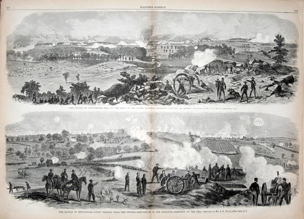 As the nation prepares to celebrate Independence Day, Americans also commemorate the 150th anniversary of the two key turning points of the Civil War - Gettysburg and Vicksburg. Lee had planned his second invasion of the North to be a "Yorktown" for the Confederacy's war for independence. Striking a major blow in Pennsylvania and possibly capturing its capital would have sent shock waves in the North and may have forced Lincoln to negotiate, possibly even accept compromise. However, Lee's plans were thwarted at Gettysburg and those final charges from Seminary Ridge on July 3rd represented the "high tide of the Confederacy," the subtitle of historian Carl Smith's book on the battle. Never again would Lee command such a force and never again would he have such an opportunity to win the war making the secession of the southern states permanent. The losses at Gettysburg were staggering with casualty numbers approaching 50,000 lives. While devastating to both sides, the Confederacy had more to lose.
 Though Gettysburg remains the more famous of the two turning points, especially because of Lincoln's immortal address there four months later, the capture of Vicksburg also on July 4th, 1863 is just as significant in turning the tide in favor of the Union in the Civil War. Vicksburg was the Confederacy's last stronghold on the Mississippi and after months of a difficult siege, General John C. Pemberton saw no other option but to surrender the city to Ulysses S. Grant. With this capture, the Union now firmly controlled the Mississippi River, surrounding the Confederacy and literally starving it into eventual surrender as control of the waterway severed the cattle supply from Texas. As Lincoln later remarked, "the Father of Waters again goes unvexed to the sea" undoubtably noting the importance of the river to the commerce of the entire region (Goodwin, Team of Rivals, 2005).
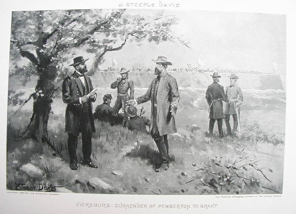
These two Confederate losses culminating on such an important day of heritage for both sides delivered a crushing blow to southern morale and effectively doomed any realistic hope for southern independence. More importantly however, these two federal victories brought about a change in Union tactics that would ultimately lead to victory, a victory that secured a "new birth of freedom," the ending of slavery, and proved that our republican form of government would "not perish from the earth."
A century and a half later, Americans are learning about these key events in a variety of ways. On Twitter, I followed a lecture delivered at Gettysburg by my former Civil War professor, Dr. Aaron Sheehan-Dean now of the University of West Virginia. I shared several quotes from his lecture with my followers this past weekend. With the advent of the History Channel, social media and other sites, more Americans are easily able to engage in history and examine artifacts that a few decades ago were only accessible to a small number of historians. This makes for a very exciting anniversary and one in which ordinary Americans can gain a better appreciation for the consequential decisions of the Civil War that brought the nation from the brink of schism and on a path of dramatic growth in the years to follow.
Resources:
Twitter hashtags: #CW150 #Gettysburg150 #Vicksburg150
Recommended to follow: @prologuepast, @gettysburgNMP, @SmithsonianCW, @CWTrust150
Technology on the Gettysburg battlefield
A Cutting Edge Second Look at the Battle of GettysburgTuesday, May 21, 2013
Video Tributes
Last week, I embarked on an experimental project-based learning activity with my standard and honors classes. As mentioned in my previous post, the students amazed me with their creativity, collaboration and their willingness to work through challenges to create video presentations.
Below are the videos they created. Overall, the results are remarkable! Some of these videos are very powerful, some are entertaining and all are fascinating. The videos are ordered as follows:
Below are the videos they created. Overall, the results are remarkable! Some of these videos are very powerful, some are entertaining and all are fascinating. The videos are ordered as follows:
- September 11th - very powerful!
- Cold War: Nuclear Disasters, Cold War Intelligence and the Space Race
- Protest and Rebellion: Civil Rights, Woodstock, Hippies
- War: World War II and Vietnam
- The Sixties: Tribute to JFK and 1960s Overview
- The Twenties: Roaring 1920s and Women of the 1920s
- Local History: Jacksonville
Saturday, May 18, 2013
#eduwinning - A Great Week to be a Teacher!
This has been an extremely busy, yet very rewarding week as a teacher! I am extremely fortunate to be doing a job I love and to be able to work at an outstanding Catholic, college-preparatory school (of course, I'm biased because Bishop Kenny is my alma mater). But, this week in particular has been quite fun in and out of the classroom. Let me re-cap...
For my AP U.S. History students, we began the week by finishing our review for Wednesday's AP exam.
In addition to review time in class, many students stayed after school on Monday for an additional (and optional) hour and a half review session. Despite being a long day, they were energetic, knowledgeable and they impressed me with their understanding of history.
When they came out of the exam on Wednesday, the consensus was that they were well prepared. I'm hopeful that nine months of hard work and analysis will pay off with good results on this exam.
We finished the week with a trip to St. Augustine. This is a great time to visit St. Augustine as the oldest city
prepares to celebrate its 450th anniversary in 2015 and Florida continues its 500th anniversary celebration. We had a very ambitious schedule, yet we accomplished all of our objectives and had a great time. The students did everything I had hoped: they represented themselves well, they learned from the historic sites and artifacts, they asked questions and explored the city. Even more, they seemed to really enjoy themselves!
In the coming week, I will blog more specifically about the trip with pictures from our various stops.
For my standard and honors U.S. History students, the week was also just as exciting. On Monday, we wrapped up our last units of material and spent the rest of the week in our school's wireless computer lab working on a video creation project. This project was an experiment for me. Last year, I directed a project with my honors classes where each class produced a video "tribute" to a generation. The project resulted in two videos, one dedicated to the "Greatest Generation" and the other to the "Baby Boom Generation." In completing these videos, I directly managed the design and production. This year, I decided to let the students have full control of the project from start to finish.
On the first day in the lab, each class was divided into three or four teams. Each team had to pick a topic, choose a team leader and begin work. I was amazed at how quickly students became engaged in their work. Each group demonstrated creativity, collaboration and patience as we experienced several technical issues in the lab. Despite the challenges, most groups finished by the end of the week - even while I was away on Friday. We still have a couple groups that will upload Monday and Tuesday due to some technical issues in the lab. Once all videos are uploaded, I will make a separate blog post to showcase all of their videos along with more details about the mechanics of the project.
While all of this was going on, I continued to grade oral history papers from my standard and honors students. This is an annual paper assignment where I ask students to interview someone who experienced a historical event first-hand and then write about that experience, the event and the historical significance. While it takes me a few weeks to grade these papers, I thoroughly enjoy reading the stories. Already, I have read some fascinating stories from war veterans and average citizens who experienced life-changing events. This is one of my favorite assignments because it allows me to learn new information and new perspectives. I also hope that the conversation with an older family member, friend, teacher or acquaintance is a meaningful experience for each student.
Overall, I walked out of the classroom Friday evening with a big smile on my face and a longing to get back to work on Monday. I am grateful to my students for being so willing to learn and making each day exciting.
I can certainly mark this week as an #eduwin ! If you don't know what that means, check it out as a hashtag on Twitter or see this site: http://www.whatisyoureduwin.com/
For my AP U.S. History students, we began the week by finishing our review for Wednesday's AP exam.
In addition to review time in class, many students stayed after school on Monday for an additional (and optional) hour and a half review session. Despite being a long day, they were energetic, knowledgeable and they impressed me with their understanding of history.
When they came out of the exam on Wednesday, the consensus was that they were well prepared. I'm hopeful that nine months of hard work and analysis will pay off with good results on this exam.
 |
| Students entering the Castillo de San Marcos |
prepares to celebrate its 450th anniversary in 2015 and Florida continues its 500th anniversary celebration. We had a very ambitious schedule, yet we accomplished all of our objectives and had a great time. The students did everything I had hoped: they represented themselves well, they learned from the historic sites and artifacts, they asked questions and explored the city. Even more, they seemed to really enjoy themselves!
In the coming week, I will blog more specifically about the trip with pictures from our various stops.
For my standard and honors U.S. History students, the week was also just as exciting. On Monday, we wrapped up our last units of material and spent the rest of the week in our school's wireless computer lab working on a video creation project. This project was an experiment for me. Last year, I directed a project with my honors classes where each class produced a video "tribute" to a generation. The project resulted in two videos, one dedicated to the "Greatest Generation" and the other to the "Baby Boom Generation." In completing these videos, I directly managed the design and production. This year, I decided to let the students have full control of the project from start to finish.
On the first day in the lab, each class was divided into three or four teams. Each team had to pick a topic, choose a team leader and begin work. I was amazed at how quickly students became engaged in their work. Each group demonstrated creativity, collaboration and patience as we experienced several technical issues in the lab. Despite the challenges, most groups finished by the end of the week - even while I was away on Friday. We still have a couple groups that will upload Monday and Tuesday due to some technical issues in the lab. Once all videos are uploaded, I will make a separate blog post to showcase all of their videos along with more details about the mechanics of the project.
While all of this was going on, I continued to grade oral history papers from my standard and honors students. This is an annual paper assignment where I ask students to interview someone who experienced a historical event first-hand and then write about that experience, the event and the historical significance. While it takes me a few weeks to grade these papers, I thoroughly enjoy reading the stories. Already, I have read some fascinating stories from war veterans and average citizens who experienced life-changing events. This is one of my favorite assignments because it allows me to learn new information and new perspectives. I also hope that the conversation with an older family member, friend, teacher or acquaintance is a meaningful experience for each student.
Overall, I walked out of the classroom Friday evening with a big smile on my face and a longing to get back to work on Monday. I am grateful to my students for being so willing to learn and making each day exciting.
I can certainly mark this week as an #eduwin ! If you don't know what that means, check it out as a hashtag on Twitter or see this site: http://www.whatisyoureduwin.com/
Tuesday, April 2, 2013
Florida 500
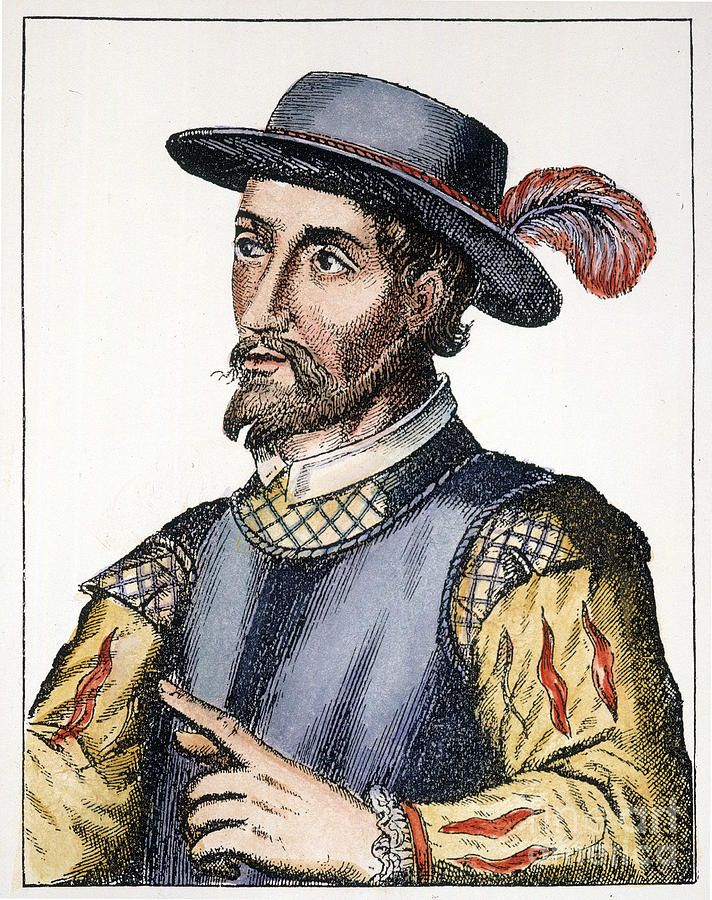 |
| Juan Ponce de Leon Image Credit: fineartamerica.com |
The first permanent settlement did not come until 1565 when Pedro Menendez de Aviles landed in today's St. Augustine. There, his chaplain celebrated the first Catholic Mass in today's United States.
 |
| This is a replica of the baptismal font used to baptize Ponce de Leon in Spain in 1474. This replica arrived at the Cathedral-Basilica of St. Augustine in time for the Anniversary Mass to be celebrated on April 3, 2013. Info |
This is simply a short summary of Florida's very rich and dynamic history. Florida also has a very rich Catholic history which also will be celebrated this week, including a Mass celebrated tomorrow at the Cathedral-Basilica of St. Augustine. The Bishop of St. Augustine, the Most Reverend Felipe Estevez, is certainly well-versed in Florida's Catholic history as evident by his homily given at his installation in 2011 (linked here). Check out the resources below for more information on Florida history!
Viva Florida!

Book Recommendations:
I had the opportunity to read several books on Florida history as a student at the University of North Florida. I had the privilege of learning under Dr. Daniel Schafer, one of the leading historians of state history and author of several books on key people in Florida History. Here are a few of my favorite books on Florida:
- The New History of Florida edited by Michael Gannon (1996)
- The Oldest City: St. Augustine Saga of Survival edited by Jean Parker Waterbury and published by the St. Augustine Historical Society (1983)
- Patrick D. Smith's A Land Remembered (1984). This is a historical fiction novel set in Old Florida. The novel portrays three generations of the MacIvey family who experience the frontier history of Florida from the 1860s through the twentieth century. This book presented such a gripping story that I easily journeyed through its 400 pages in only a few days.
- James B. Crook's Jacksonville: The Consolidation Story, from Civil Rights to the Jaguars (2004). I am certainly an enthusiast for my hometown and this is a great recent history book on Jacksonville!
- A good read on the Catholic history of St. Augustine is Charles Gallagher's Cross & Crozier: A History of the Diocese of St. Augustine (1999).
- Viva Florida! The official state website for the 500th Anniversary.
- St. Augustine Catholic's "From the Archives" Section
- The Florida History Internet Center
- Florida History Online - This is a project of the University of North Florida. I remember when this project began in the early 2000s. I was a student at the time and with the Internet becoming a mainstream component of American life, many organizations sought to place artifacts and exhibits normally isolated to a museum online in "virtual exhibits."
- The Museum of Florida History
- 450th Anniversary of St. Augustine (Events from Old City)
- Official 450th St. Augustine Site
- Florida Memory - Comprehensive site managed by the State Library System
- Hashtags: #florida500, #vivaflorida
- @VivaFlorida - Official Twitter handle for the State's 500th Anniversary
- @StAugustine450 - 450th Anniversary of St. Augustine
- @FLMemory
Subscribe to:
Posts (Atom)
