Showing posts with label Civil War at 150. Show all posts

Sunday, August 2, 2015

History Wars

It has been almost a year since my last post, a product of a very busy year that has left little time to write.  This past school year witnessed the launch of the new AP U.S. History curriculum, in my classroom and throughout the nation.  The newly designed framework has been met with much controversy and enough concern to warrant revisions for the upcoming school year.

Despite Vice President of AP Trevor Parker dismissing the criticisms in a recent letter to all "APUSH" teachers (link), I must respectfully disagree with his characterization of these criticisms as "egregious misrepresentations."  While this particular teacher welcomed the functional changes to the exam and especially its emphasis on the skills of a historian, the concept outline did present a perspective of United States history concerning to some, including me.  Those who subscribe to a Howard Zinn view of history will find nothing wrong in the framework; however, an overemphasis of some topics and a lack of inclusion of others is startling, at least in my opinion. Regardless of the "perspective" of the new curriculum, the new framework does allow for flexibility.  Therefore, it has been my goal over the past
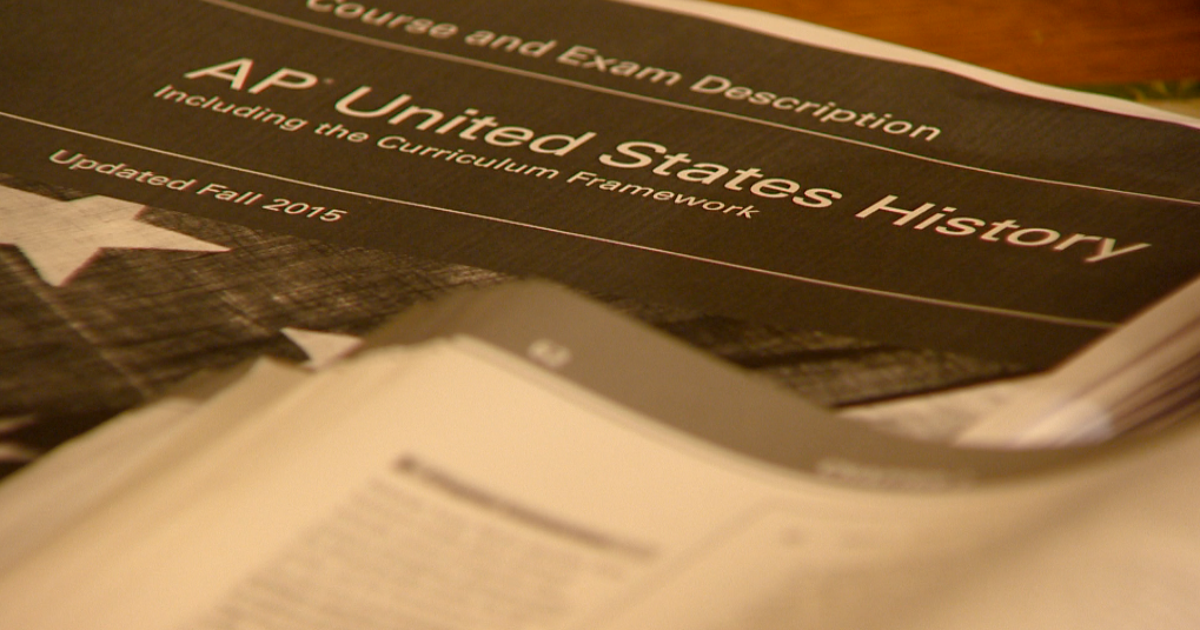
Since writing this blog post while on vacation in
the Carolina Mountains, the College Board has just
released the "updated" version, shown here.
(Credit: 9news.com)
year to provide the appropriate balance of historical interpretation.  As I frequently mention in class, my job is not to teach what to think, but how to think. Simply because I disagree with the emphasis on negative elements of our history does not mean that I ignore those aspects or cover them with less attention.  I believe that our nation's history stands as one of the most remarkable in history and despite our faults, there is much to celebrate about a nation that just in recent decades rid the world of totalitarianism and has done more than any other to promote freedom and democracy around the globe.  However, in celebrating our past, we must come to terms with mistakes and failures.  Historian Paul Johnson (1998) said it best, "America is a great problem-creating country but also a great problem-solving country."  He offers this example: America "created chattel slavery on a scale never before experienced in the world, but it solved it after much time, blood, sweat and tears."  The effects of this are still a work in progress today, but at least we enjoy the freedom to debate and discern how to address problems and resolve controversy.  Not everyone in this world is as fortunate.
The reaction to the new framework also demonstrates the true nature of the field of history.  Our historical understanding is impacted by the context of present day and history is controversial.  The
Carving to Confederate Generals on
Stone Mountain, Georgia
(credit: WSB-TV)
recent debate regarding the Confederate flag illustrates this well.  History can also be reaffirming.  It can serve as a source of patriotism and identity, but also a source of scorn.  History can be personal and it is often when it becomes personal that ordinary people pay more attention.  I have witnessed some passionately defend their ancestry by vehemently arguing that southern secession and slavery were unrelated, despite the overwhelming evidence to the contrary. 

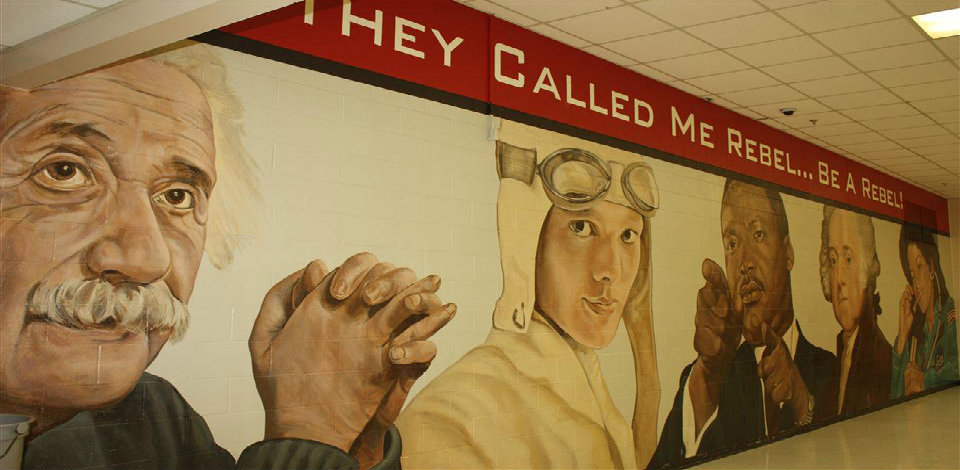
Mural from the Nathan B. Forrest High School Cafeteria.
The school's name was changed to Westside High for the
2014-2015 school year. (Source: wjct.org)


This is what keeps my job exhilarating.  Students sometimes question why I remain so excited about teaching the "same story" over and over.  The reality is that each of the past eleven years has been different.  Each year offers some new perspective or some new interest based upon a recent book I have read or some new controversy in the news.  The integration of technology and the evolution of how we learn in the classroom also continues to evolve.  I continue to evolve in my own teaching as I release more of the responsibility for learning to the students themselves.  While this may cause concern for some in the profession (oh no, what if they get it wrong?), the results have been truly remarkable.  Just in the past year, I've watched students produce compelling and engaging presentations of historical material, address topics outside the normal curriculum and make learning personal by interviewing family members on their experience with past events and using what they learned to produce moving tributes to their past generation or even specifically to members of their family. 

The study of history deserves - rather, our youth deserve a genuine opportunity to learn history and in doing so, to make their own decisions regarding interpretation.  Gone are the days where students learned simply what a textbook author deemed important.  Students must have the freedom to evaluate the past, good and bad, as well as evaluate the implications of the past on their lives and our society.  I hope that the forthcoming revision to the "revised framework" will restore an appropriate balance to the historical narrative and will return some important topics noticeably absent in its current form.  Regardless of what the College Board decides, in my classroom, we will continue to consider all perspectives and all sides, while also allowing students to offer their own interpretations and interests.  We will engage the historical thinking skills that the new curriculum appropriately requires while challenging all perspectives of the past.


Note: McPherson is one of the most respected historians in the field today


Saturday, November 23, 2013

Lincoln, Kennedy and the Field of History


This week, the nation commemorated the anniversary of two important and monumental events in American History - the 150th Anniversary of the Gettysburg Address and the 50th Anniversary of President John F. Kennedy's assassination in Dallas.  These two events - and the national discussion this week - illustrate how history impacts each of us and is relevant to us today.  I am writing this post from the National Council of the Social Studies Annual Conference in St. Louis. These two commemorations have been the subject of several sessions this week and certainly a hot topic among historians and history educators.

Lincoln's Gettysburg Address redefined the meaning of the Civil War.  Lincoln gave this speech months after the epic battle and even though it had been months, there were still bodies left to be collected on the battlefield.  A celebrated speaker of the day spoke for two hours, Lincoln followed him with a speech of only two and a half minutes.  His brief yet eloquent remarks defined the Civil War as a "test" to see whether this nation, built as a constitutional republic of "the people," would survive.  As Joy Hakim, author of Freedom: A History of US, remarked in her presentation yesterday, Lincoln's short speech illustrated how the presidency had transformed him and how he became the great moral leader of the nation, even if he did not recognize it.  As I have mentioned in class and written here before, Lincoln's greatest strengths in guiding the nation through the trauma of this war rests in his incredible vision to see the conflict through, his ability to unite or at least manage his political rivals for the common cause of union and his astounding ability to phrase powerful messages in so few of words.  Lincoln was passionate at saving the nation and preserving the entire union, as well as achieving a peace that finally put slavery to rest yet ensured the future harmony of the republic.  Of course, Lincoln's vision evolved as the office transformed him and he transformed the office.  The Gettysburg Address illustrates this transformation and demonstrates Lincoln's deep, reflective intelligence shaped by the traumatic events of the war and the sadness in his personal life.  In this regard, Lincoln and Kennedy share some similarities towards the end of their lives.

The Kennedy Assassination a century later also demonstrates an important turning point in American history.  The decade of the sixties represents another upheaval in our nation's history where Americans were challenged by the fears of the Cold War, the pursuit of equality in the civil rights movement, a dramatic change in American culture and the trauma of the Vietnam War.  The Kennedy Assassination leaves us with many questions.  Was Oswald the lone assassin or part of a wider conspiracy?  How would the 1960s have been different if Kennedy had lived?  What is the true legacy of the Kennedy presidency?  These and other questions have been the subject of several sessions here in St. Louis and of course, in the national media this week.  In addition to the presentations here and the television coverage, several historical organizations and news sites have been posting a minute-by-minute account of the Kennedy assassination on Twitter using the hashtag #JFK50.  Even though I was born in 1980 and not alive for the event, I have been able to re-live those days through social media.

Both of these events demonstrate how history also evokes controversy.  The Gettysburg anniversary may have passed with a national discussion focused solely on Lincoln and the Civil War.  However, President Obama not attending the event in Gettysburg and then, dropping the phrase "under God" from his re-reading of the speech in a video message set off a political firestorm where the focus shifted away from the event of 150 years ago to a discussion of more recent politics.  

Yesterday, I attended a session with film director Oliver Stone (JFK, Born on the Fourth of July) and Dr. Peter Kuznick, authors of The Untold History of the United States.  When the session began with a remark on how terrible our nation had become under George W. Bush, I knew immediately where this one was headed.  At the end of the session, Oliver Stone recommended that education and the nation would be better if we could get "those damn Republicans" out of office.  Will that evoke controversy? Yes, but it brings up an important lesson.  Learning history is exhilarating.  What do we really know about the past?  Who writes history?  Why are the events of the past so relevant to us today?  Where do we stand on the controversial event and/or controversial interpretations of history?  The other lesson is to always recognize that everyone has a bias.  Tread carefully.

In yesterday's presentation, we heard Oliver Stone's perspective on the Kennedy assassination as a major conspiracy.  In fact, government involvement - maybe even Lyndon Johnson himself - was implied, or at least Stone raised the question.  Today, I listened to David Keck who has spent years researching the event who disagrees with many of the key points of Stone's speech and the JFK film.  What does this tell us?  This is what makes learning history so compelling. 

To understand history is not to learn a chain of events or a particular interpretation of history.  When we simply study stories of history in a classroom, we only learn one interpretation - the interpretation of the one choosing the stories.  My challenge as a history teacher is to teach the skills of historical inquiry, to teach students to think like historians and sometimes not like historians - to question what we know.  These anniversaries and related controversies illustrate the need for good historical inquiry, grounded on factual evidence.  Students, help me to be this teacher - ask questions, challenge what we learn.

Post note: Tonight, I will be listening to Harold Holzer and "The Making of Steven Speilberg's Lincoln."  Tomorrow, we plan to attend Mass at the Old Cathedral, visit museums and then make the journey home.  I will post pictures of St. Louis later in the week.


Monday, July 1, 2013

A New Birth of Freedom

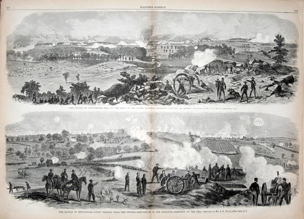
Battle of Gettysburg from Harper's WeeklyAs the nation prepares to celebrate Independence Day, Americans also commemorate the 150th anniversary of the two key turning points of the Civil War - Gettysburg and Vicksburg.  Lee had planned his second invasion of the North to be a "Yorktown" for the Confederacy's war for independence.  Striking a major blow in Pennsylvania and possibly capturing its capital would have sent shock waves in the North and may have forced Lincoln to negotiate, possibly even accept compromise.  However, Lee's plans were thwarted at Gettysburg and those final charges from Seminary Ridge on July 3rd represented the "high tide of the Confederacy," the subtitle of historian Carl Smith's book on the battle.  Never again would Lee command such a force and never again would he have such an opportunity to win the war making the secession of the southern states permanent.  The losses at Gettysburg were staggering with casualty numbers approaching 50,000 lives.  While devastating to both sides, the Confederacy had more to lose.
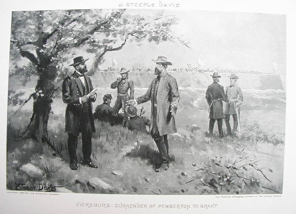
Though Gettysburg remains the more famous of the two turning points, especially because of Lincoln's immortal address there four months later, the capture of Vicksburg also on July 4th, 1863 is just as significant in turning the tide in favor of the Union in the Civil War.  Vicksburg was the Confederacy's last stronghold on the Mississippi and after months of a difficult siege, General John C. Pemberton saw no other option but to surrender the city to Ulysses S. Grant.  With this capture, the Union now firmly controlled the Mississippi River, surrounding the Confederacy and literally starving it into eventual surrender as control of the waterway severed the cattle supply from Texas.  As Lincoln later remarked, "the Father of Waters again goes unvexed to the sea" undoubtably noting the importance of the river to the commerce of the entire region (Goodwin, Team of Rivals, 2005).Surrender of Pemberton to Grant

These two Confederate losses culminating on such an important day of heritage for both sides delivered a crushing blow to southern morale and effectively doomed any realistic hope for southern independence.  More importantly however, these two federal victories brought about a change in Union tactics that would ultimately lead to victory, a victory that secured a "new birth of freedom," the ending of slavery, and proved that our republican form of government would "not perish from the earth."

A century and a half later, Americans are learning about these key events in a variety of ways.  On Twitter, I followed a lecture delivered at Gettysburg by my former Civil War professor, Dr. Aaron Sheehan-Dean now of the University of West Virginia.  I shared several quotes from his lecture with my followers this past weekend.  With the advent of the History Channel, social media and other sites, more Americans are easily able to engage in history and examine artifacts that a few decades ago were only accessible to a small number of historians.  This makes for a very exciting anniversary and one in which ordinary Americans can gain a better appreciation for the consequential decisions of the Civil War that brought the nation from the brink of schism and on a path of dramatic growth in the years to follow.

Resources:

Twitter hashtags: #CW150 #Gettysburg150 #Vicksburg150

Recommended to follow: @prologuepast, @gettysburgNMP, @SmithsonianCW, @CWTrust150

Technology on the Gettysburg battlefield

A Cutting Edge Second Look at the Battle of Gettysburg

Photographs of the Civil War from the Library of Congress

Tuesday, January 1, 2013

Lincoln and Emancipation

Last week, I finished Doris Kearns Goodwin's comprehensive book, Team of Rivals. The central theme of this book is the "political genius of Abraham Lincoln." Goodwin meticulously examines the lives of Lincoln and his cabinet from their youth to the 1860 Republican Convention and throughout the four-year struggle of the Civil War. While the focus is on Lincoln, she also closely examines the lives of his political rivals who became part of his official political family - the cabinet. Assembling a cabinet of Republican rivals and Democrats, all who believed in 1860 that Lincoln was unqualified to be chief executive, truly was a strike of genius, especially on the brink of the worst crisis ever experienced by our nation. Though at times it seemed that Lincoln was swayed or even controlled by some in the cabinet, especially Seward, Lincoln truly was the captain at the helm. He utilized the diversity of his cabinet and even their competitiveness to strengthen the Union cause and effectively manage a challenging war, despite numerous obstacles and setbacks.

Lincoln Memorial, Washington, DC
(M. Broach, 2005)
Goodwin's book became the basis for Steven Spielberg's blockbuster hit, Lincoln, now appearing in theaters. Both the film and the book capture Lincoln's uniquely dynamic and attractive personality. It truly was Lincoln's charisma, insightful leadership and appealing good nature that made him the ideal president for guiding the union through four years of bloody civil war. It is hard to imagine how the nation would have fared if a Stephen Douglas, William Henry Seward or Salmon Chase had been president. Though Lincoln certainly could be moved on particular issues, he usually had a strongly formed position on the major issues of the day and then guided the nation, a union of radicals, moderates and conservatives, towards that position. He timed major decisions well and was uniquely able to disarm critics with an anecdote or story to prove a point. Even some of Lincoln's harshest critics came to see the wisdom of his vision: an indivisible nation that fulfilled the dream of the Founding Fathers - a republic of the people dedicated to the "proposition that all men are created equal."

This is a picture of the actual
Emancipation Proclamation (photo:
M. Broach, 2005)

Scanned Version
Today marks the 150th anniversary of the Emancipation Proclamation. This single act catapulted Lincoln to the fame he enjoys today and served as the critical turning point of the Civil War, making the Union cause one of freedom instead of simply political reunion. From early on, Lincoln detested slavery and viewed it as a moral evil. However, as a lawyer and politician, he held the view of many that it was a constitutionally protected institution in the South. As president, in the absence of war, he could only forbid slavery in lands controlled by the federal government - the western territories. This was his platform in the Election of 1860.  After the first shots of the Civil War, Radical Republicans and abolitionists pushed incessantly for emancipation. However, Lincoln hesitated, citing the cause of union as more important and questioning whether or not he had the legal authority to make such a bold move. As the war progressed and Union commanders began confiscating slaves as enemy property, the concept of emancipation loomed heavily on Lincoln and his cabinet. Lincoln took the wise view that he could not make any move until the Union had a significant victory on the battlefield. Furthermore, Lincoln still believed that any blanket emancipation order might drive the border states to the Confederacy or be held as legally invalid once the war concluded. Therefore, when the Emancipation Proclamation was announced in September 1862 after the victory at Antietam, it only applied to areas still in rebellion against the United States as of January 1, 1863. Lincoln was able to justify his legal qualms by using his extraordinary powers as commander-in-chief to issue this proclamation as a military measure in suppressing the rebellion. While some abolitionists criticized this move as a weak response to demands for ending slavery, Lincoln wisely knew that this action would help put slavery on the path of extinction. This proclamation also opened the door to the enlistment of colored troops, a critical dynamic in filling Union troop needs and as a powerful symbol to the South. Furthermore, by changing the nature of war from one of suppressing rebellion to one of ending slavery, the Emancipation Proclamation effectively closed the door to potential diplomatic recognition for the Confederacy by Great Britain or France.

The Thirteenth Amendment
(National Archives)
While the Emancipation Proclamation was Lincoln's tool for suppressing rebellion and winning the war, it was the first critical step in permanently ending slavery in the United States, especially with the promise that slaves would be "thenceforward and forever free."  As the Union finally began to turn the tide against the Confederacy and victory seemed near, Lincoln worked hard - despite warnings from his cabinet members - on a final solution to the slavery question, the Thirteenth Amendment. While some believed that Lincoln should wait for the end of the war to work on such an amendment, he instinctively knew that the promise of freedom for those African-Americans already freed by the Emancipation Proclamation must be secured before the end of the war less they be returned to bondage. The only way to ensure that he achieved the vision of finally ending slavery was to have the constitutional protection of freedom passed before the political debates of Reconstruction could take away the hopes of millions of slaves and former slaves.

The ending of slavery made the Civil War a second revolution, finally achieving the ideals espoused by the Founding Fathers.

As always, I conclude with additional resources:

Wednesday, May 30, 2012

Milestones

Over six months have passed since my last blog post.  Why?  New baby, busy family and a busy work schedule.  These are good reasons, right?  Now that the school year is closing, I finally have a chance to write.

This year marks several significant anniversaries in U.S. and local history - and an exciting time to study history.   Here's a compilation of the milestones of 2012 (in order):

450th Anniversary of the French Arrival on the First Coast
In May of 1562, French explorer Jean Ribault entered what the French called the "River May," today the St. Johns River.  The French later founded Fort Caroline on a high river bluff which became a refuge for Huguenots escaping religious persecution.  The French did not last very long at Ft. Caroline after their slaughter in 1565 by Pedro Menendez of Spain.  Though the French did attempt to re-settle here, they were never successful at regaining a foothold in Florida.  Instead, Florida became a Spanish possession and the river was re-named for Saint John.

I took this picture on the AP U.S. History field trip to Fort Caroline on May 17th.

For further information about this milestone, explore the following:

225th Anniversary of the United States Constitution
In an election year filled with questions of constitutionality and the proper role of the federal government, it is very timely that we mark this important milestone.  The United States Constitution of 1787 is our nation's second constitution, the first being the ineffective Articles of Confederation.

To the right is a picture I took of the actual Constitution at the National Archives in 2005.

As this anniversary approaches, be sure to follow the hashtag #constitution225 on Twitter

200th Anniversary of the War of 1812
The War of 1812 is often considered America's second war for independence.  Though militarily this war was a disaster resulting in the burning of the national capitol and emerging sectionalism, the two and half years of war did result in a surge of nationalism and the drafting of the Star Spangled Banner, later to become the national anthem.  Andrew Jackson's fame was solidified as the victor of New Orleans and Americans began to move west in stronger numbers.  By standing up to the British, the United States legitimized itself as an independent nation.

I have acquired several books on the War of 1812 and I hope to have more posts later this summer.

Some additional resources:


150th Anniversary: Civil War Events of 1862, the Homestead Act and the Pacific Railway Act
I have written several posts regarding the 150th anniversary of the Civil War.  The year 1862 was certainly pivotal as by the close of the year, a long and deadly conflict was now impossible to avoid, a fact now recognized by both sides.  Bloody battles at Shiloh, Antietam and in Virginia foreshadowed the terrible years to come.  By September, Lincoln had issued his Emancipation Proclamation fundamentally changing the war from one of union to one for freedom.

With southern Democrats absent from Congress, Republicans were able to pass two significant laws, the Homestead Act and the Pacific Railway Act.  These acts opened the west to settlement with free land, business opportunities and an emerging transcontinental railroad network.

To the right is a picture of a homestead grant, taken at the National Archives in 2005.

For further interest:

  • Twitter - #CW150 #HomesteadAct150
  • The Homestead National Monument of America in Nebraska - on Twitter @HomesteadNM
  • Union Pacific's 150th Anniversary Website:  http://www.up150.com/
75th Anniversary: The Golden Gate Bridge
Last week, San Francisco celebrated the 75th anniversary of the Golden Gate Bridge.  A technological marvel for its day, the Golden Gate bridge rose above San Francisco Bay at a time when Americans needed a sense of hope, trying desperately to rise above the worst economic depression in history.

Here's a picture I took from the San Francisco side of the bridge in September 2006 while my wife and I were on our honeymoon.


50th Anniversary: The Cuban Missile Crisis
October marks the fiftieth anniversary of the Cuban Missile Crisis, the climax of tensions in the Cold War and the closest the United States and the Soviet Union came to the brink of thermonuclear war.  As I read oral history papers submitted by my students, I continue to learn more about the true fear experienced by Americans during those thirteen troubling days.  One colleague recently shared a story with me about how he, as a second grader here in Jacksonville, wore a dog tag and was issued ration cans in case the civil defense alarms sounded.  I doubt many students in the United States today could share such an experience.

Jacksonville certainly was on heightened alert in those days with three major naval bases all within Duval County.

In regards to the Cold War, since the release of Russian documents after the fall of the Soviet Union in 1991, historians are learning much more about the very real dangers of the era.

Conclusion


Every year brings a series of anniversaries, though this year does include some of the most significant events in U.S. history. Why do these commemorations and celebrations matter?  Will our knowledge of these events change or improve just because this is an anniversary year?  Maybe.

These anniversaries and commemorations matter because they enhance our collective "American memory."  Celebrating or remembering historical events helps us connect to our national story and build a sense of heritage.  Anniversaries also help reinvigorate discussions and debates on key historical issues - as several of this year's commemorations demonstrate.


Wednesday, November 2, 2011

The Civil War at 150

The 150th Commemoration of the Civil War began last December (2010) with the first 150th anniversary, the anniversary of South Carolina's secession.  Obviously, the Civil War is of large importance to United States History.  It truly is a critical turning point in our nation’s history and can be seen as a second American Revolution.  American politics, society and the economy, even geography in some places, were drastically changed through four years of bitter war.  Hundreds of thousands were slaughtered by their own countrymen and millions of lives were affected.  As I mentioned in a previous post, civil wars are usually the least civil of wars and the trauma of this war rattled a generation and shaped the future of the nation.

Even though this is a pivotal event in history textbooks, the understanding of it is not limited to textbooks, websites or the published works of historians.  A century and a half later, this event is still debated today.  It still hooks the interest of ordinary people around the world.  The Civil War is the most written about single event in world history.  Walk into any bookstore and you will find volumes of recently published works all about this one war 150 years ago. (See my previous post)

One popular topic of debate, and one of the many reasons this event is still so thoroughly studied today, is the root cause of the war: the debate on slavery.  The Civil War simply cannot be understood without understanding slavery as the core issue.  As I write this, I know that some disagree on this point.

Since I will most likely be gone on “paternity leave” when we discuss this topic in class, I leave you with the following items:

1. Viewing slavery as a cause for secession is still controversial today.  Here’s an example from Jon Stewart’s The Daily Show.  (I’m not usually a fan of this show, but it does bring forth some valid discussion)

2. Why is there such a controversy?
Here are some historians on this point:
(sorry about the advertisement, wish I could help that! be sure to stop the clip at the end)

3. Questions for Class Discussion:

  • Why does naming slavery as the main cause of the Civil War (though there are others) create so much controversy today?
  • Why do some high school history teachers find it difficult to teach about slavery? (some teachers I have encountered at conferences are very uncomfortable even discussing slavery)
  • How is this commemoration of the Civil War (the 150th) different from previous commemorations (50th, 100th, etc)?
  • Why does the Civil War still receive such attention, by historians, by ordinary people, by Hollywood?
  • Is it appropriate for states to allow the Confederate flag to be displayed in public buildings?

For further interest, here are a few additional resources on this topic:


Saturday, July 30, 2011

End of Summer and New Beginnings

The end of summer break draws near and I have finished my summer reading with Edward J. Larson's 1997 book, Summer for the Gods.  In this text, Larson gave an in-depth analysis of the famed Scopes Monkey Trial, the events leading to the trial, the trial itself, its immediate aftermath, legacies and historiography.  This particular case truly was the "case of the (20th) century" and marked a key moment in America's ongoing debate on science, religion and education.  Furthermore, it was a key event in the early-1900s emergence of modernism and reactions to modernism, an ideology that the Catholic Church responded to under the leadership of Popes Pius X, Benedict XV and Pius XI (*).  It is also an event that is often misunderstood today, especially with erroneous "histories" written decades later and the popularity of the fictitious and certainly not historically-accurate play turned film, Inherit the Wind

*Note: I try to include some Catholic history whenever possible.

As I turn my attention to a new school year and another journey through American History, I look forward to my eighth run of reading, analyzing and discussing the history of our people and our nation with bright, young minds.  This year in particular will bring some important developments in the field of United States History:

1. The continuation of the 150th Commemoration of the Civil War which I have already written about here
2. The 10-year anniversary of the attacks of September 11th.

The Organization of American Historians has dedicated this quarter's issue of the Magazine of History to 9/11.  In reading the first few articles, it is evident that at least the opening historians have a very negative view of the consequences of September 11th and the responses of President George W. Bush.  While I will avoid discussing or challenging those opinions here, it does bring to light this point (or opinion): It is simply too soon to give true historical analysis without the temptation to include one's political beliefs.  I hope that this tenth anniversary will be a time to properly remember those who lost their lives that day, to remember those who gave the ultimate sacrifice in the line of duty and to remember those soldiers who gave their lives in the years that followed.  Certainly, the legacies of September 11th are still with us and I hope that a genuine commemoration will take place.

I look forward to a new school year of conversation on these and other issues in our nation's past, present and future.

As always, I conclude with a few links:

Thursday, July 21, 2011

The war has begun


Today marks the 150th anniversary of the first major battle of the Civil War at Manassas, Virginia (or as more commonly known, Bull Run).  It was this battle that served as the first sign that this would not be a short and limited war, but one of overwhelming destruction and one that would become a second American Revolution.  My goal was to finish John Keegan's book, The American Civil War: A Military History by today.  I accomplished that goal last night.

I learned so much from Keegan's book that it would be too much to recount here.  The military history of this four-year national saga is one of logistics, of using and overcoming geography and as a human story, of engaging ordinary citizens in shear horrific battle.  Here are just a few examples that prove how massive and traumatic this four-year-struggle was for the ordinary American citizens who lived through it or perished by it:
  • Approximately 10,000 battles were fought, 237 were named (Keegan, 362, 77).
  • Death toll: Approximately 620,000 - 360,000 Union and 260,000 Confederate; Total casualties (dead, wounded or missing) rank much higher than that (Stats: Keegan, 77).
  • There was no large professional army in the United States in 1861 which meant that ordinary citizens had to learn as they fought which only increased the casualty numbers.
  • Given the horrors of battle, lethal technology and the spreading of disease, one would expect high amounts of desertion and surrender.  However, whether through loyalty to comrades, to cause or out of a desire to preserve one's dignity, most of these ordinary citizens continued to fight courageously.
Of course, when studying the Civil War, we are left with the question of why.  Why did this war begin and linger so long? Why did Americans fight and continue to fight?

Studying the evidence, it is irrefutable that the debate over slavery and its extension west was the root cause of the secession crisis.  Certainly, most Confederate soldiers did not own slaves and many had very few encounters with African-Americans.  It can be said that for the ordinary citizens of the Confederacy, they fought to preserve the rights of their state.  For many northerners, the cause for which they fought was the preservation of the national union and though some were fervent abolitionists, most in the North were not.  However, the question of race and slavery remained at the core of the national discussion on both sides and it simply cannot be ignored.  Yet, making these statements today is still controversial, especially in the South.

Why is this?  For the southern perspective, many of the memoirs and histories written in the fifty years after Appomattox were intended to redeem the image of the South, a people recovering from the defeat of a traumatic and passionate conflict.  The arguments of these "Lost Cause" historians as well as the depictions in the famous novel turned film, Gone with the Wind, made their way into what historians refer to as "American Memory," the collective knowledge of history by ordinary people.

This is just one aspect of the controversy.  It is my hope that over the next four years of this 150th commemoration, we can reopen the national discussion of the Civil War and truly understand the war, its causes and consequences for what they truly were.  I hope that the distance of 150 years can provide some objectivity to the discussion and that we have an opportunity as Americans to truly learn from and appreciate our shared national heritage.

As always, I will conclude with links for further reading and review:


Monday, June 20, 2011

Welcome to my blog!

Since graduating college and beginning my teaching career, I began a tradition of "pleasure reading" in the summer when I'm not so inundated with student papers and planning for six classes. Of course, pleasure reading for me is reading history. I am fortunate that my profession is also my hobby. During the break, I usually select a particular time period or a range of topics and then further my knowledge.

This summer, I've spent so much time working on new technology for the classroom and keeping up with my two-year-old, I have not read as much... yet. I recently started Liberty's Exiles, a book that gives a voice to the thousands of "Loyalists" in the American Revolution, an often forgot-about group of historical figures.

One improvement I hope to make this summer is to blog about what I read and what I learn from books, articles or other discoveries. Check back soon for my thoughts on Liberty's Exiles.

I started something similar to this project a few years ago when I published my notes on the First Amendment and "separation of church and state" debate based on a series of readings. Here's a link to those notes:
http://www.broachweb.com/docs/history/separation-churchandstate.htm

Other topics I hope to pursue with this blog are the various discussions among historians and everyday Americans regarding the Civil War. This past December, we as Americans began the four-year commemoration of the 150th anniversary of the Civil War. How is the Civil War remembered today? Why does it still evoke controversy in classrooms and among everyday people?
Here's a few resources I have referenced in class or found online (from my links page).

I hope you enjoy this blog and I look forward to this new experience.
Related Posts Plugin for WordPress, Blogger...