Showing posts with label American Memory. Show all posts

Sunday, August 2, 2015

History Wars

It has been almost a year since my last post, a product of a very busy year that has left little time to write.  This past school year witnessed the launch of the new AP U.S. History curriculum, in my classroom and throughout the nation.  The newly designed framework has been met with much controversy and enough concern to warrant revisions for the upcoming school year.

Despite Vice President of AP Trevor Parker dismissing the criticisms in a recent letter to all "APUSH" teachers (link), I must respectfully disagree with his characterization of these criticisms as "egregious misrepresentations."  While this particular teacher welcomed the functional changes to the exam and especially its emphasis on the skills of a historian, the concept outline did present a perspective of United States history concerning to some, including me.  Those who subscribe to a Howard Zinn view of history will find nothing wrong in the framework; however, an overemphasis of some topics and a lack of inclusion of others is startling, at least in my opinion. Regardless of the "perspective" of the new curriculum, the new framework does allow for flexibility.  Therefore, it has been my goal over the past
Since writing this blog post while on vacation in
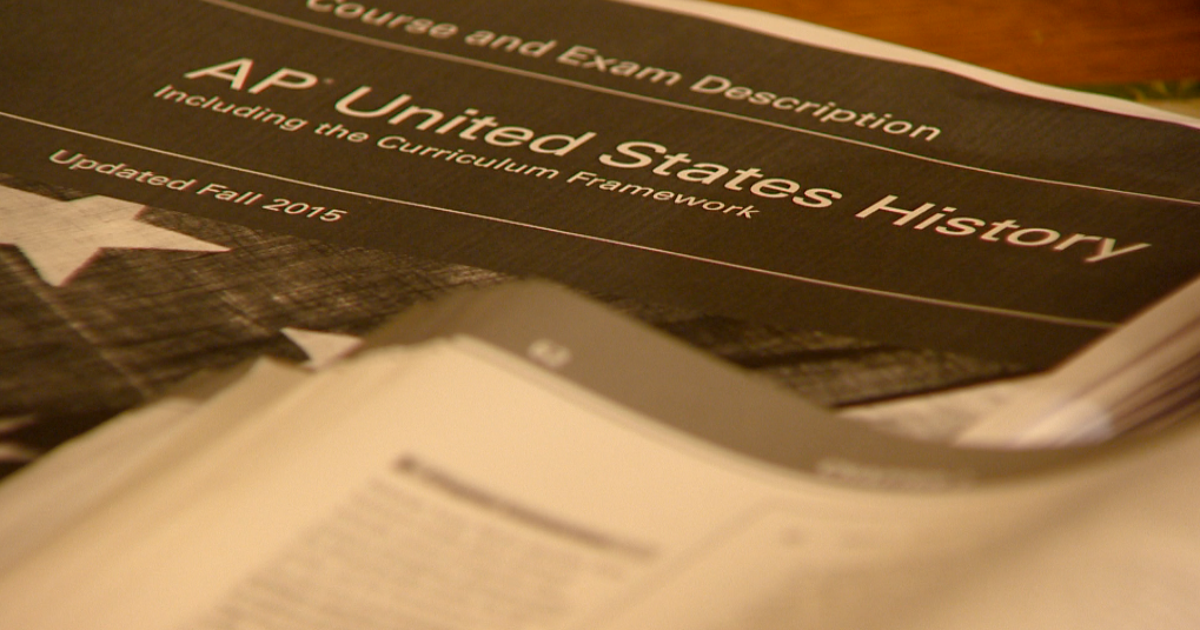
the Carolina Mountains, the College Board has just
released the "updated" version, shown here.
(Credit: 9news.com)
year to provide the appropriate balance of historical interpretation.  As I frequently mention in class, my job is not to teach what to think, but how to think. Simply because I disagree with the emphasis on negative elements of our history does not mean that I ignore those aspects or cover them with less attention.  I believe that our nation's history stands as one of the most remarkable in history and despite our faults, there is much to celebrate about a nation that just in recent decades rid the world of totalitarianism and has done more than any other to promote freedom and democracy around the globe.  However, in celebrating our past, we must come to terms with mistakes and failures.  Historian Paul Johnson (1998) said it best, "America is a great problem-creating country but also a great problem-solving country."  He offers this example: America "created chattel slavery on a scale never before experienced in the world, but it solved it after much time, blood, sweat and tears."  The effects of this are still a work in progress today, but at least we enjoy the freedom to debate and discern how to address problems and resolve controversy.  Not everyone in this world is as fortunate.
The reaction to the new framework also demonstrates the true nature of the field of history.  Our historical understanding is impacted by the context of present day and history is controversial.  The
Carving to Confederate Generals on
Stone Mountain, Georgia
(credit: WSB-TV)
recent debate regarding the Confederate flag illustrates this well.  History can also be reaffirming.  It can serve as a source of patriotism and identity, but also a source of scorn.  History can be personal and it is often when it becomes personal that ordinary people pay more attention.  I have witnessed some passionately defend their ancestry by vehemently arguing that southern secession and slavery were unrelated, despite the overwhelming evidence to the contrary. 

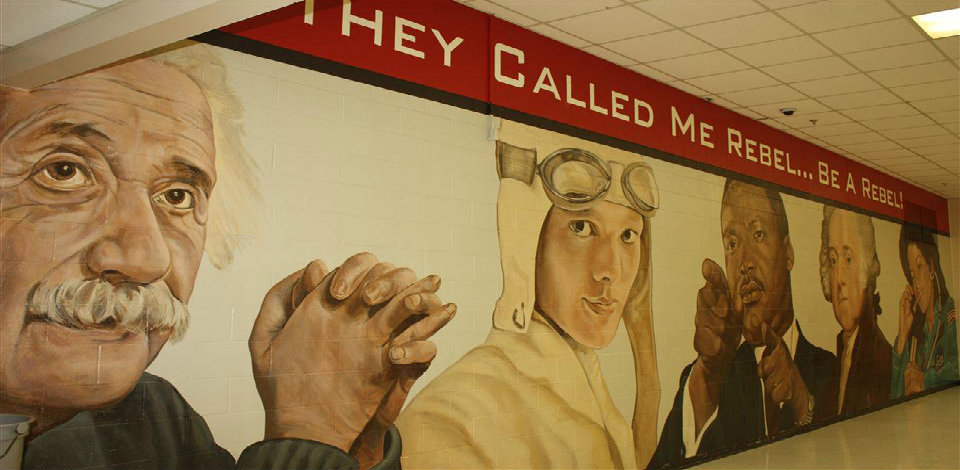
Mural from the Nathan B. Forrest High School Cafeteria.
The school's name was changed to Westside High for the
2014-2015 school year. (Source: wjct.org)


This is what keeps my job exhilarating.  Students sometimes question why I remain so excited about teaching the "same story" over and over.  The reality is that each of the past eleven years has been different.  Each year offers some new perspective or some new interest based upon a recent book I have read or some new controversy in the news.  The integration of technology and the evolution of how we learn in the classroom also continues to evolve.  I continue to evolve in my own teaching as I release more of the responsibility for learning to the students themselves.  While this may cause concern for some in the profession (oh no, what if they get it wrong?), the results have been truly remarkable.  Just in the past year, I've watched students produce compelling and engaging presentations of historical material, address topics outside the normal curriculum and make learning personal by interviewing family members on their experience with past events and using what they learned to produce moving tributes to their past generation or even specifically to members of their family. 

The study of history deserves - rather, our youth deserve a genuine opportunity to learn history and in doing so, to make their own decisions regarding interpretation.  Gone are the days where students learned simply what a textbook author deemed important.  Students must have the freedom to evaluate the past, good and bad, as well as evaluate the implications of the past on their lives and our society.  I hope that the forthcoming revision to the "revised framework" will restore an appropriate balance to the historical narrative and will return some important topics noticeably absent in its current form.  Regardless of what the College Board decides, in my classroom, we will continue to consider all perspectives and all sides, while also allowing students to offer their own interpretations and interests.  We will engage the historical thinking skills that the new curriculum appropriately requires while challenging all perspectives of the past.


Note: McPherson is one of the most respected historians in the field today


Saturday, November 23, 2013

Lincoln, Kennedy and the Field of History


This week, the nation commemorated the anniversary of two important and monumental events in American History - the 150th Anniversary of the Gettysburg Address and the 50th Anniversary of President John F. Kennedy's assassination in Dallas.  These two events - and the national discussion this week - illustrate how history impacts each of us and is relevant to us today.  I am writing this post from the National Council of the Social Studies Annual Conference in St. Louis. These two commemorations have been the subject of several sessions this week and certainly a hot topic among historians and history educators.

Lincoln's Gettysburg Address redefined the meaning of the Civil War.  Lincoln gave this speech months after the epic battle and even though it had been months, there were still bodies left to be collected on the battlefield.  A celebrated speaker of the day spoke for two hours, Lincoln followed him with a speech of only two and a half minutes.  His brief yet eloquent remarks defined the Civil War as a "test" to see whether this nation, built as a constitutional republic of "the people," would survive.  As Joy Hakim, author of Freedom: A History of US, remarked in her presentation yesterday, Lincoln's short speech illustrated how the presidency had transformed him and how he became the great moral leader of the nation, even if he did not recognize it.  As I have mentioned in class and written here before, Lincoln's greatest strengths in guiding the nation through the trauma of this war rests in his incredible vision to see the conflict through, his ability to unite or at least manage his political rivals for the common cause of union and his astounding ability to phrase powerful messages in so few of words.  Lincoln was passionate at saving the nation and preserving the entire union, as well as achieving a peace that finally put slavery to rest yet ensured the future harmony of the republic.  Of course, Lincoln's vision evolved as the office transformed him and he transformed the office.  The Gettysburg Address illustrates this transformation and demonstrates Lincoln's deep, reflective intelligence shaped by the traumatic events of the war and the sadness in his personal life.  In this regard, Lincoln and Kennedy share some similarities towards the end of their lives.

The Kennedy Assassination a century later also demonstrates an important turning point in American history.  The decade of the sixties represents another upheaval in our nation's history where Americans were challenged by the fears of the Cold War, the pursuit of equality in the civil rights movement, a dramatic change in American culture and the trauma of the Vietnam War.  The Kennedy Assassination leaves us with many questions.  Was Oswald the lone assassin or part of a wider conspiracy?  How would the 1960s have been different if Kennedy had lived?  What is the true legacy of the Kennedy presidency?  These and other questions have been the subject of several sessions here in St. Louis and of course, in the national media this week.  In addition to the presentations here and the television coverage, several historical organizations and news sites have been posting a minute-by-minute account of the Kennedy assassination on Twitter using the hashtag #JFK50.  Even though I was born in 1980 and not alive for the event, I have been able to re-live those days through social media.

Both of these events demonstrate how history also evokes controversy.  The Gettysburg anniversary may have passed with a national discussion focused solely on Lincoln and the Civil War.  However, President Obama not attending the event in Gettysburg and then, dropping the phrase "under God" from his re-reading of the speech in a video message set off a political firestorm where the focus shifted away from the event of 150 years ago to a discussion of more recent politics.  

Yesterday, I attended a session with film director Oliver Stone (JFK, Born on the Fourth of July) and Dr. Peter Kuznick, authors of The Untold History of the United States.  When the session began with a remark on how terrible our nation had become under George W. Bush, I knew immediately where this one was headed.  At the end of the session, Oliver Stone recommended that education and the nation would be better if we could get "those damn Republicans" out of office.  Will that evoke controversy? Yes, but it brings up an important lesson.  Learning history is exhilarating.  What do we really know about the past?  Who writes history?  Why are the events of the past so relevant to us today?  Where do we stand on the controversial event and/or controversial interpretations of history?  The other lesson is to always recognize that everyone has a bias.  Tread carefully.

In yesterday's presentation, we heard Oliver Stone's perspective on the Kennedy assassination as a major conspiracy.  In fact, government involvement - maybe even Lyndon Johnson himself - was implied, or at least Stone raised the question.  Today, I listened to David Keck who has spent years researching the event who disagrees with many of the key points of Stone's speech and the JFK film.  What does this tell us?  This is what makes learning history so compelling. 

To understand history is not to learn a chain of events or a particular interpretation of history.  When we simply study stories of history in a classroom, we only learn one interpretation - the interpretation of the one choosing the stories.  My challenge as a history teacher is to teach the skills of historical inquiry, to teach students to think like historians and sometimes not like historians - to question what we know.  These anniversaries and related controversies illustrate the need for good historical inquiry, grounded on factual evidence.  Students, help me to be this teacher - ask questions, challenge what we learn.

Post note: Tonight, I will be listening to Harold Holzer and "The Making of Steven Speilberg's Lincoln."  Tomorrow, we plan to attend Mass at the Old Cathedral, visit museums and then make the journey home.  I will post pictures of St. Louis later in the week.


Wednesday, August 28, 2013

The Dream

As readers of my blog recognize, I love milestone anniversaries of historic events.  These public anniversaries bring the conversations of history out of the typical academic settings and into the forefront of mainstream, public discussion.  They engage Americans in our shared past.

Today marks the 50th anniversary since the famous March on Washington and Martin Luther King, Jr.'s "I Have a Dream" speech.  Fifty years later, we are now at a tipping point where less Americans are old enough to have directly experienced the civil rights movement.  For the masses of younger Americans who did not experience this time period first-hand, we are the beneficiaries of this era.  But as we assess Dr. King's speech, we must ask: Is the dream fulfilled?  Does American society today reflect what this speech envisions?  If the answer is no, then why not and what must change?  These are just a few challenging questions that important historical anniversaries raise and important questions to raise as we shape the future of our great nation.

Resources:


Monday, July 1, 2013

A New Birth of Freedom

Battle of Gettysburg from Harper's WeeklyAs the nation prepares to celebrate Independence Day, Americans also commemorate the 150th anniversary of the two key turning points of the Civil War - Gettysburg and Vicksburg.  Lee had planned his second invasion of the North to be a "Yorktown" for the Confederacy's war for independence.  Striking a major blow in Pennsylvania and possibly capturing its capital would have sent shock waves in the North and may have forced Lincoln to negotiate, possibly even accept compromise.  However, Lee's plans were thwarted at Gettysburg and those final charges from Seminary Ridge on July 3rd represented the "high tide of the Confederacy," the subtitle of historian Carl Smith's book on the battle.  Never again would Lee command such a force and never again would he have such an opportunity to win the war making the secession of the southern states permanent.  The losses at Gettysburg were staggering with casualty numbers approaching 50,000 lives.  While devastating to both sides, the Confederacy had more to lose.
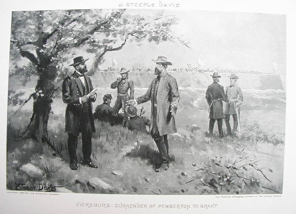
Though Gettysburg remains the more famous of the two turning points, especially because of Lincoln's immortal address there four months later, the capture of Vicksburg also on July 4th, 1863 is just as significant in turning the tide in favor of the Union in the Civil War.  Vicksburg was the Confederacy's last stronghold on the Mississippi and after months of a difficult siege, General John C. Pemberton saw no other option but to surrender the city to Ulysses S. Grant.  With this capture, the Union now firmly controlled the Mississippi River, surrounding the Confederacy and literally starving it into eventual surrender as control of the waterway severed the cattle supply from Texas.  As Lincoln later remarked, "the Father of Waters again goes unvexed to the sea" undoubtably noting the importance of the river to the commerce of the entire region (Goodwin, Team of Rivals, 2005).Surrender of Pemberton to Grant

These two Confederate losses culminating on such an important day of heritage for both sides delivered a crushing blow to southern morale and effectively doomed any realistic hope for southern independence.  More importantly however, these two federal victories brought about a change in Union tactics that would ultimately lead to victory, a victory that secured a "new birth of freedom," the ending of slavery, and proved that our republican form of government would "not perish from the earth."

A century and a half later, Americans are learning about these key events in a variety of ways.  On Twitter, I followed a lecture delivered at Gettysburg by my former Civil War professor, Dr. Aaron Sheehan-Dean now of the University of West Virginia.  I shared several quotes from his lecture with my followers this past weekend.  With the advent of the History Channel, social media and other sites, more Americans are easily able to engage in history and examine artifacts that a few decades ago were only accessible to a small number of historians.  This makes for a very exciting anniversary and one in which ordinary Americans can gain a better appreciation for the consequential decisions of the Civil War that brought the nation from the brink of schism and on a path of dramatic growth in the years to follow.

Resources:

Twitter hashtags: #CW150 #Gettysburg150 #Vicksburg150

Recommended to follow: @prologuepast, @gettysburgNMP, @SmithsonianCW, @CWTrust150

Technology on the Gettysburg battlefield

A Cutting Edge Second Look at the Battle of Gettysburg

Photographs of the Civil War from the Library of Congress

Tuesday, May 21, 2013

Video Tributes

Last week, I embarked on an experimental project-based learning activity with my standard and honors classes.  As mentioned in my previous post, the students amazed me with their creativity, collaboration and their willingness to work through challenges to create video presentations.

Below are the videos they created.  Overall, the results are remarkable!  Some of these videos are very powerful, some are entertaining and all are fascinating.  The videos are ordered as follows:


  • September 11th - very powerful!
  • Cold War: Nuclear Disasters, Cold War Intelligence and the Space Race
  • Protest and Rebellion: Civil Rights, Woodstock, Hippies
  • War: World War II and Vietnam
  • The Sixties: Tribute to JFK and 1960s Overview
  • The Twenties: Roaring 1920s and Women of the 1920s
  • Local History: Jacksonville


Tuesday, April 2, 2013

Florida 500

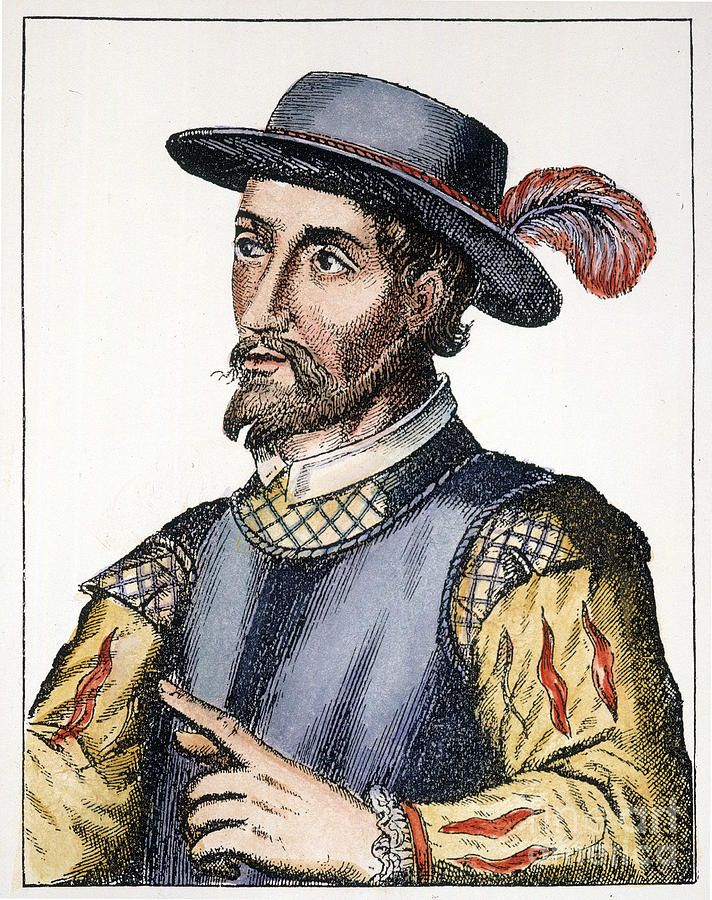
Juan Ponce de Leon
Image Credit: fineartamerica.com
Today is the 500th anniversary of Juan Ponce de Leon's discovery of Florida. In search of a "fountain of youth" and the obligatory Spanish goals of God, Glory and Gold (and not always in that order), Ponce de Leon landed on the east coast of Florida on April 2nd, 1513. The discovery was named Pascua de la Florida after the Easter "Feast of Flowers."

The first permanent settlement did not come until 1565 when Pedro Menendez de Aviles landed in today's St. Augustine. There, his chaplain celebrated the first Catholic Mass in today's United States.

This is a replica of the baptismal font used
to baptize Ponce de Leon in Spain in 1474.
This replica arrived at the Cathedral-Basilica of
St. Augustine in time for the Anniversary Mass
to be celebrated on April 3, 2013.
Info
The initial discovery of Florida five hundred years ago set off a very rich history for this peninsula, as well as shaping the colonial and naval development for three imperial powers - Spain, France and Britain. Florida provided a vital role because of its location to the Gulf Stream, an oceanic highway of sorts that connects shipping lanes of the Caribbean and Gulf of Mexico back to Europe via the North Atlantic. Spanish Florida expelled French Huguenots from Ft. Caroline on the St. John's River and the colony became a thorn to its British colonial neighbors to the north. After the Seven Years (a.k.a. French and Indian) War, Florida entered a 20-year period of British rule (1763-1783). Spanish and British architecture is still evident in St. Augustine today. After the U.S. War for Independence, Florida returned to Spanish rule and Loyalist exiles from  the British North American colonies were expelled, causing their second major migration in only a few years. After decades of shaky Spanish rule and an invasion by Andrew Jackson, Spain ceded Florida to the United States in 1819. The territory gained statehood status in 1845. By that time, the capital had moved from St. Augustine to Tallahassee. This was considered an ideal location as it was mid-way between the two most important cities at the time, St. Augustine and Pensacola. In 1861, Florida seceded from the Union, following the lead of six other slave states of the Deep South. Though Florida did not serve a central role in the Civil War due to its sparse population, its geographic location was vital. Florida was a cattle-rich state and its cattle fed the Confederacy. The Battle of Olustee and the occupation of Jacksonville were intended to cut off the cattle supply for the Confederacy, one segment of the Union's "Anaconda Plan." After the Civil War, Florida experienced a tremendous period of growth from the late 1800s well into the twentieth century. Jacksonville flourished as a tourist destination and the trade port of Tampa grew exponentially. Former Rockefeller associate Henry Flagler built railroads in the state. With a railroad to South Florida in the early twentieth century, combined with canal projects that made the land habitable, the development of the Miami region began.  This set off the largest period of growth in the state and a century that would witness an explosion of population due to the country's "sunbelt" migration as well as new job opportunities, including those created by NASA.  Florida's warm climate and sandy beaches already attracted plenty of tourists.  Tourism would explode in the state with the opening of Walt Disney World in 1971. Today, Florida continues to attract both tourists and new residents and remains one of the fastest growing states in the union.

This is simply a short summary of Florida's very rich and dynamic history.  Florida also has a very rich Catholic history which also will be celebrated this week, including a Mass celebrated tomorrow at the Cathedral-Basilica of St. Augustine.  The Bishop of St. Augustine, the Most Reverend Felipe Estevez, is certainly well-versed in Florida's Catholic history as evident by his homily given at his installation in 2011 (linked here).  Check out the resources below for more information on Florida history!

Viva Florida!


Book Recommendations:
I had the opportunity to read several books on Florida history as a student at the University of North Florida.  I had the privilege of learning under Dr. Daniel Schafer, one of the leading historians of state history and author of several books on key people in Florida History.  Here are a few of my favorite books on Florida:

  • The New History of Florida edited by Michael Gannon (1996)
  • The Oldest City: St. Augustine Saga of Survival edited by Jean Parker Waterbury and published by the St. Augustine Historical Society (1983)
  • Patrick D. Smith's A Land Remembered (1984).  This is a historical fiction novel set in Old Florida.  The novel portrays three generations of the MacIvey family who experience the frontier history of Florida from the 1860s through the twentieth century.  This book presented such a gripping story that I easily journeyed through its 400 pages in only a few days.  
  • James B. Crook's Jacksonville: The Consolidation Story, from Civil Rights to the Jaguars (2004).  I am certainly an enthusiast for my hometown and this is a great recent history book on Jacksonville!
  • A good read on the Catholic history of St. Augustine is Charles Gallagher's Cross & Crozier: A History of the Diocese of St. Augustine (1999).
Web Resources:

Twitter:

  • Hashtags: #florida500, #vivaflorida
  • @VivaFlorida - Official Twitter handle for the State's 500th Anniversary
  • @StAugustine450 - 450th Anniversary of St. Augustine
  • @FLMemory
Past Blog Posts:

Wednesday, July 11, 2012

Presidential Politics

This summer, I decided to shape my reading list around presidential politics (of course, after I finished the War of 1812 book).  This is an area of history that has always fascinated me, ever since I took a political science course on the modern presidency in college.  I also figured that this would be a timely move given the dramatic election season that is well underway.

The Official Presidential Seal
I just completed two books related to the presidency.  First was The Presidents Club by Nancy Gibbs and Michael Duffy.  This book gave a detailed look inside the most exclusive fraternity in the world, the privileged club of presidents.  Gibbs and Duffy chronicled the relationships of sitting presidents and ex-presidents, from the time Harry Truman reached out to Herbert Hoover to today, the relationship of Barack Obama and his predecessors.  Throughout these stories, the authors point out the basic rules - whether spoken or not - that presidents obey in "the club."  While most of these relationships have been cordial, not all presidents (and ex-presidents) have followed the rules.  Some were notoriously devious while some, despite bitter elections and rhetoric, have been amazingly gracious.  At times, this book seemed like a soap opera and fittingly, I had a hard time putting it down (just ask my wife!).

Here's a good blog post with images of the presidential fraternity:
http://wskg.org/pbs/former-presidents-look-one-another-advice-friendship

The second book and my third of the summer was George W. Bush's Decision Points.  Presidential memoirs have become an expectation for ex-presidents and they do serve an important historical purpose - shedding light into the complicated decision making process of a president.  Once a president leaves office, he faces the judgment of history.  Naturally, presidents hope to influence their legacy in the prism of history.  This was certainly the case when Ulysses S. Grant published his famous Memoirs in the remaining months of his life.  President Bush's memoir is focused on the most consequential decisions of his presidency, including very important events in recent history - 9/11, the wars in Afghanistan and Iraq, Katrina, just to name a few.  It may be too soon for historians to assess the Bush presidency; however, this book is an insightful look at how President Bush shaped his decisions and why he made the decisions he did.  Bush notes his achievements, but also admits mistakes.  Where I find this book most helpful is how President Bush lays out the major events of his term in a topical sense, clearly illustrating each major decision as part of a larger chain of events.  It is easy for pundits and even us Americans to judge a president in the moment, when the decisions are made.  However, reading this president's rationale and in the context of events and facts, including those not known to the public at the time, lends to a much better understanding of the decisions and the man.  Regardless of one's politics and regardless of whether readers agree or disagree with Mr. Bush, this book does help shed light into one of the more momentous presidencies in recent history.

The next item on my summer reading list is Michael Beschloss' Presidential Courage: Brave Leaders and How They Changed America, 1789-1989.  Beschloss is a renowned presidential historian, appearing in many documentaries on the modern presidency and author of several works.  I had the opportunity to hear him speak at the Florida Forum in October 2008, just prior to the election of Barack Obama.

I close with a image collection of ex-presidents and related images for this post.


Monday, June 18, 2012

Union 1812

Today, on the 200th anniversary of the official declaration of war against Britain, I finished my first book of the summer - A.J. Langguth's Union 1812.  This is one of many books I have read on this topic - especially as James Madison and the founding period was my focus in college.

In many respects, the War of 1812 was a disaster.  Once again, Americans were mismatched against the world's leading military power and the nation suffered many losses culminating in the burning of Washington in 1814.  Yet, this war marks an important turning point in the nation's early history.

Langguth makes the analogy that starting this war was the new republic's way of challenging Britain to a duel in order to preserve her sacred honor.  In the decades since the Revolution, Britain and France often trampled on America's neutrality and sovereignty.  Indian alliances, often encouraged by the British in Canada, represented a dangerous threat to frontier-seeking Americans.  To a younger generation of founders, those who did not fight in the first war for independence, the only solution was to stand up for the rights of the nation even though many of the older founders, men like Jefferson and Madison, were reluctant to support such a gamble.

Despite the limited successes and tremendous blunders of the war, the republic survived and as a result, gained more respect abroad.  With the defeat of the formidable Indian confederacies and a new sense of national pride at the end of the war, Americans vigorously moved west and laid the foundations for a market revolution.  An industrial boom in the North resulted from years of embargo and war and politically, the era that followed would be labeled one of "good feelings."  Sectionalism was dealt a black eye with the failure of the Hartford Convention, yet the long-term effects of this war would cause a resurgence of sectionalism as the nation pushed west and faced the inevitable question on the existence and expansion of slavery.

Related links:

Wednesday, May 30, 2012

Milestones

Over six months have passed since my last blog post.  Why?  New baby, busy family and a busy work schedule.  These are good reasons, right?  Now that the school year is closing, I finally have a chance to write.

This year marks several significant anniversaries in U.S. and local history - and an exciting time to study history.   Here's a compilation of the milestones of 2012 (in order):

450th Anniversary of the French Arrival on the First Coast
In May of 1562, French explorer Jean Ribault entered what the French called the "River May," today the St. Johns River.  The French later founded Fort Caroline on a high river bluff which became a refuge for Huguenots escaping religious persecution.  The French did not last very long at Ft. Caroline after their slaughter in 1565 by Pedro Menendez of Spain.  Though the French did attempt to re-settle here, they were never successful at regaining a foothold in Florida.  Instead, Florida became a Spanish possession and the river was re-named for Saint John.

I took this picture on the AP U.S. History field trip to Fort Caroline on May 17th.

For further information about this milestone, explore the following:

225th Anniversary of the United States Constitution
In an election year filled with questions of constitutionality and the proper role of the federal government, it is very timely that we mark this important milestone.  The United States Constitution of 1787 is our nation's second constitution, the first being the ineffective Articles of Confederation.

To the right is a picture I took of the actual Constitution at the National Archives in 2005.

As this anniversary approaches, be sure to follow the hashtag #constitution225 on Twitter

200th Anniversary of the War of 1812
The War of 1812 is often considered America's second war for independence.  Though militarily this war was a disaster resulting in the burning of the national capitol and emerging sectionalism, the two and half years of war did result in a surge of nationalism and the drafting of the Star Spangled Banner, later to become the national anthem.  Andrew Jackson's fame was solidified as the victor of New Orleans and Americans began to move west in stronger numbers.  By standing up to the British, the United States legitimized itself as an independent nation.

I have acquired several books on the War of 1812 and I hope to have more posts later this summer.

Some additional resources:


150th Anniversary: Civil War Events of 1862, the Homestead Act and the Pacific Railway Act
I have written several posts regarding the 150th anniversary of the Civil War.  The year 1862 was certainly pivotal as by the close of the year, a long and deadly conflict was now impossible to avoid, a fact now recognized by both sides.  Bloody battles at Shiloh, Antietam and in Virginia foreshadowed the terrible years to come.  By September, Lincoln had issued his Emancipation Proclamation fundamentally changing the war from one of union to one for freedom.

With southern Democrats absent from Congress, Republicans were able to pass two significant laws, the Homestead Act and the Pacific Railway Act.  These acts opened the west to settlement with free land, business opportunities and an emerging transcontinental railroad network.

To the right is a picture of a homestead grant, taken at the National Archives in 2005.

For further interest:

  • Twitter - #CW150 #HomesteadAct150
  • The Homestead National Monument of America in Nebraska - on Twitter @HomesteadNM
  • Union Pacific's 150th Anniversary Website:  http://www.up150.com/
75th Anniversary: The Golden Gate Bridge
Last week, San Francisco celebrated the 75th anniversary of the Golden Gate Bridge.  A technological marvel for its day, the Golden Gate bridge rose above San Francisco Bay at a time when Americans needed a sense of hope, trying desperately to rise above the worst economic depression in history.

Here's a picture I took from the San Francisco side of the bridge in September 2006 while my wife and I were on our honeymoon.


50th Anniversary: The Cuban Missile Crisis
October marks the fiftieth anniversary of the Cuban Missile Crisis, the climax of tensions in the Cold War and the closest the United States and the Soviet Union came to the brink of thermonuclear war.  As I read oral history papers submitted by my students, I continue to learn more about the true fear experienced by Americans during those thirteen troubling days.  One colleague recently shared a story with me about how he, as a second grader here in Jacksonville, wore a dog tag and was issued ration cans in case the civil defense alarms sounded.  I doubt many students in the United States today could share such an experience.

Jacksonville certainly was on heightened alert in those days with three major naval bases all within Duval County.

In regards to the Cold War, since the release of Russian documents after the fall of the Soviet Union in 1991, historians are learning much more about the very real dangers of the era.

Conclusion


Every year brings a series of anniversaries, though this year does include some of the most significant events in U.S. history. Why do these commemorations and celebrations matter?  Will our knowledge of these events change or improve just because this is an anniversary year?  Maybe.

These anniversaries and commemorations matter because they enhance our collective "American memory."  Celebrating or remembering historical events helps us connect to our national story and build a sense of heritage.  Anniversaries also help reinvigorate discussions and debates on key historical issues - as several of this year's commemorations demonstrate.


Thursday, July 21, 2011

The war has begun


Today marks the 150th anniversary of the first major battle of the Civil War at Manassas, Virginia (or as more commonly known, Bull Run).  It was this battle that served as the first sign that this would not be a short and limited war, but one of overwhelming destruction and one that would become a second American Revolution.  My goal was to finish John Keegan's book, The American Civil War: A Military History by today.  I accomplished that goal last night.

I learned so much from Keegan's book that it would be too much to recount here.  The military history of this four-year national saga is one of logistics, of using and overcoming geography and as a human story, of engaging ordinary citizens in shear horrific battle.  Here are just a few examples that prove how massive and traumatic this four-year-struggle was for the ordinary American citizens who lived through it or perished by it:
  • Approximately 10,000 battles were fought, 237 were named (Keegan, 362, 77).
  • Death toll: Approximately 620,000 - 360,000 Union and 260,000 Confederate; Total casualties (dead, wounded or missing) rank much higher than that (Stats: Keegan, 77).
  • There was no large professional army in the United States in 1861 which meant that ordinary citizens had to learn as they fought which only increased the casualty numbers.
  • Given the horrors of battle, lethal technology and the spreading of disease, one would expect high amounts of desertion and surrender.  However, whether through loyalty to comrades, to cause or out of a desire to preserve one's dignity, most of these ordinary citizens continued to fight courageously.
Of course, when studying the Civil War, we are left with the question of why.  Why did this war begin and linger so long? Why did Americans fight and continue to fight?

Studying the evidence, it is irrefutable that the debate over slavery and its extension west was the root cause of the secession crisis.  Certainly, most Confederate soldiers did not own slaves and many had very few encounters with African-Americans.  It can be said that for the ordinary citizens of the Confederacy, they fought to preserve the rights of their state.  For many northerners, the cause for which they fought was the preservation of the national union and though some were fervent abolitionists, most in the North were not.  However, the question of race and slavery remained at the core of the national discussion on both sides and it simply cannot be ignored.  Yet, making these statements today is still controversial, especially in the South.

Why is this?  For the southern perspective, many of the memoirs and histories written in the fifty years after Appomattox were intended to redeem the image of the South, a people recovering from the defeat of a traumatic and passionate conflict.  The arguments of these "Lost Cause" historians as well as the depictions in the famous novel turned film, Gone with the Wind, made their way into what historians refer to as "American Memory," the collective knowledge of history by ordinary people.

This is just one aspect of the controversy.  It is my hope that over the next four years of this 150th commemoration, we can reopen the national discussion of the Civil War and truly understand the war, its causes and consequences for what they truly were.  I hope that the distance of 150 years can provide some objectivity to the discussion and that we have an opportunity as Americans to truly learn from and appreciate our shared national heritage.

As always, I will conclude with links for further reading and review:


Monday, June 20, 2011

Welcome to my blog!

Since graduating college and beginning my teaching career, I began a tradition of "pleasure reading" in the summer when I'm not so inundated with student papers and planning for six classes. Of course, pleasure reading for me is reading history. I am fortunate that my profession is also my hobby. During the break, I usually select a particular time period or a range of topics and then further my knowledge.

This summer, I've spent so much time working on new technology for the classroom and keeping up with my two-year-old, I have not read as much... yet. I recently started Liberty's Exiles, a book that gives a voice to the thousands of "Loyalists" in the American Revolution, an often forgot-about group of historical figures.

One improvement I hope to make this summer is to blog about what I read and what I learn from books, articles or other discoveries. Check back soon for my thoughts on Liberty's Exiles.

I started something similar to this project a few years ago when I published my notes on the First Amendment and "separation of church and state" debate based on a series of readings. Here's a link to those notes:
http://www.broachweb.com/docs/history/separation-churchandstate.htm

Other topics I hope to pursue with this blog are the various discussions among historians and everyday Americans regarding the Civil War. This past December, we as Americans began the four-year commemoration of the 150th anniversary of the Civil War. How is the Civil War remembered today? Why does it still evoke controversy in classrooms and among everyday people?
Here's a few resources I have referenced in class or found online (from my links page).

I hope you enjoy this blog and I look forward to this new experience.
Related Posts Plugin for WordPress, Blogger...