Monday, July 15, 2013

The Gilded Age

When I first began my teaching career, if I were to pick one time period where I had the least amount of knowledge, it would have been the "Gilded Age" from 1877 to the turn of the century.  While I had studied some related topics in college, such as U.S. foreign policy and the "New South," I never developed a depth of knowledge for this period as I had for other time periods in United States history.  Since then, however, it has become one of my favorite time periods to study mostly because of its importance in bridging early U.S. history to the modern age of the twentieth century.  A couple weeks ago, I finished reading The American Colossus: The Triumph of Capitalism by H.W. Brands.  Brands presents an excellent analysis of the time period and the conflicting themes of democracy and capitalism in the decades following the Civil War.

I have found that my early trepidation with teaching the Gilded Age is fairly common among history educators because the period is complicated and often confusing to students.  As I tell my students, almost every textbook on United States History presents this era differently and usually breaks from chronology favoring a more thematic focus instead.  However, the importance of that thematic focus cannot be overlooked.

I begin the era by asking students to imagine that we are getting into a De Lorean.  Then, I have to explain what that is - I suppose that illustrates our generational divide (okay, for those who still don't get it - click here).  Once I get through that explanation, I ask students to go back in time and look at what life was like at the end of the Civil War.  Native Americans and buffalo still freely roamed the Plains, it took a wagon to get to the Pacific, dirt roads and horse travel defined transportation in American cities.  Further, the South was destroyed and African Americans now freed from bondage were hopeful for what free life would bring.  Industry was beginning to expand due to the war, but businesses were mostly local affairs where the business owner still directly managed the business and worked hard to make a living.  

Next, I ask students to "kick it up to 88" (still, they don't get it) and fast forward to 1900.  By the end of the century, just a short 35 years, life in America was dramatically different.  Native American culture was almost gone from the Plains and so were the buffalo.  Several transcontinental railroads stretched across the Plains reaching to the Pacific, along with the "golden wire" of the telegraph - America's first "Internet."  Many farmers who had fled to the Plains with the hope of opportunity and free land offered by the Homestead Act found themselves broke from mounting debt caused by overproduction, deflation and a multitude of other challenges.  Major industries now dominated the national economy and the industrial titans like Andrew Carnegie, John D. Rockefeller and J.P. Morgan were the most influential men in the country, not the presidents or politicians of the Gilded Age.  Cities grew up and out with the development of skyscrapers, streetcars, suspension bridges and mass transit, with automobiles coming soon.  Pollution and poverty followed with the massive surge of immigrants pouring into the cities in the last decades of the century, along with an emerging labor movement now influenced by socialism and radicalism.  A more modernized culture developed in urban areas with spectator sports and amusement parks, while the rural South moved to eliminate the gains made by blacks during Reconstruction and create a segregated society defined by "Jim Crow" laws.  Though the frontier had been declared "closed" in 1890, Americans now looked outward on the world and became a global power following the territorial and political gains of the Spanish-American War.  A truly different America existed in 1900 than 1865, an illuminated and connected national economy and culture ready for the dynamic twentieth century. 

Resources to share:

The Men Who Built America - outstanding series by the History Channel, short clips available online are good supplements for classroom discussion.

Best of History Websites - The Gilded Age (this is always a good EdTech site to look at for teaching U.S. History)

For fun, two students in my summer school class found this video of a teacher singing a jingle about the Gilded Age.  The whole class started singing along!


Monday, July 1, 2013

A New Birth of Freedom

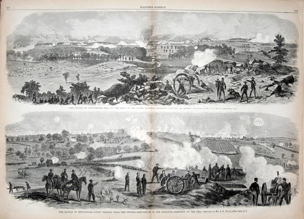
Battle of Gettysburg from Harper's WeeklyAs the nation prepares to celebrate Independence Day, Americans also commemorate the 150th anniversary of the two key turning points of the Civil War - Gettysburg and Vicksburg.  Lee had planned his second invasion of the North to be a "Yorktown" for the Confederacy's war for independence.  Striking a major blow in Pennsylvania and possibly capturing its capital would have sent shock waves in the North and may have forced Lincoln to negotiate, possibly even accept compromise.  However, Lee's plans were thwarted at Gettysburg and those final charges from Seminary Ridge on July 3rd represented the "high tide of the Confederacy," the subtitle of historian Carl Smith's book on the battle.  Never again would Lee command such a force and never again would he have such an opportunity to win the war making the secession of the southern states permanent.  The losses at Gettysburg were staggering with casualty numbers approaching 50,000 lives.  While devastating to both sides, the Confederacy had more to lose.
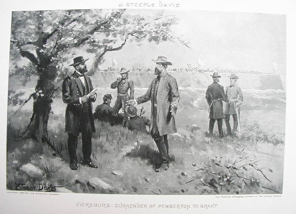
Though Gettysburg remains the more famous of the two turning points, especially because of Lincoln's immortal address there four months later, the capture of Vicksburg also on July 4th, 1863 is just as significant in turning the tide in favor of the Union in the Civil War.  Vicksburg was the Confederacy's last stronghold on the Mississippi and after months of a difficult siege, General John C. Pemberton saw no other option but to surrender the city to Ulysses S. Grant.  With this capture, the Union now firmly controlled the Mississippi River, surrounding the Confederacy and literally starving it into eventual surrender as control of the waterway severed the cattle supply from Texas.  As Lincoln later remarked, "the Father of Waters again goes unvexed to the sea" undoubtably noting the importance of the river to the commerce of the entire region (Goodwin, Team of Rivals, 2005).Surrender of Pemberton to Grant

These two Confederate losses culminating on such an important day of heritage for both sides delivered a crushing blow to southern morale and effectively doomed any realistic hope for southern independence.  More importantly however, these two federal victories brought about a change in Union tactics that would ultimately lead to victory, a victory that secured a "new birth of freedom," the ending of slavery, and proved that our republican form of government would "not perish from the earth."

A century and a half later, Americans are learning about these key events in a variety of ways.  On Twitter, I followed a lecture delivered at Gettysburg by my former Civil War professor, Dr. Aaron Sheehan-Dean now of the University of West Virginia.  I shared several quotes from his lecture with my followers this past weekend.  With the advent of the History Channel, social media and other sites, more Americans are easily able to engage in history and examine artifacts that a few decades ago were only accessible to a small number of historians.  This makes for a very exciting anniversary and one in which ordinary Americans can gain a better appreciation for the consequential decisions of the Civil War that brought the nation from the brink of schism and on a path of dramatic growth in the years to follow.

Resources:

Twitter hashtags: #CW150 #Gettysburg150 #Vicksburg150

Recommended to follow: @prologuepast, @gettysburgNMP, @SmithsonianCW, @CWTrust150

Technology on the Gettysburg battlefield

A Cutting Edge Second Look at the Battle of Gettysburg

Photographs of the Civil War from the Library of Congress

Tuesday, May 21, 2013

Video Tributes

Last week, I embarked on an experimental project-based learning activity with my standard and honors classes.  As mentioned in my previous post, the students amazed me with their creativity, collaboration and their willingness to work through challenges to create video presentations.

Below are the videos they created.  Overall, the results are remarkable!  Some of these videos are very powerful, some are entertaining and all are fascinating.  The videos are ordered as follows:


  • September 11th - very powerful!
  • Cold War: Nuclear Disasters, Cold War Intelligence and the Space Race
  • Protest and Rebellion: Civil Rights, Woodstock, Hippies
  • War: World War II and Vietnam
  • The Sixties: Tribute to JFK and 1960s Overview
  • The Twenties: Roaring 1920s and Women of the 1920s
  • Local History: Jacksonville


Saturday, May 18, 2013

#eduwinning - A Great Week to be a Teacher!

This has been an extremely busy, yet very rewarding week as a teacher!  I am extremely fortunate to be doing a job I love and to be able to work at an outstanding Catholic, college-preparatory school (of course, I'm biased because Bishop Kenny is my alma mater).  But, this week in particular has been quite fun in and out of the classroom.  Let me re-cap...

For my AP U.S. History students, we began the week by finishing our review for Wednesday's AP exam.
In addition to review time in class, many students stayed after school on Monday for an additional (and optional) hour and a half review session.  Despite being a long day, they were energetic, knowledgeable and they impressed me with their understanding of history.

When they came out of the exam on Wednesday, the consensus was that they were well prepared.  I'm hopeful that nine months of hard work and analysis will pay off with good results on this exam.

Students entering the Castillo de San Marcos
We finished the week with a trip to St. Augustine.  This is a great time to visit St. Augustine as the oldest city
prepares to celebrate its 450th anniversary in 2015 and Florida continues its 500th anniversary celebration.  We had a very ambitious schedule, yet we accomplished all of our objectives and had a great time.  The students did everything I had hoped: they represented themselves well, they learned from the historic sites and artifacts, they asked questions and explored the city.  Even more, they seemed to really enjoy themselves!

In the coming week, I will blog more specifically about the trip with pictures from our various stops.

For my standard and honors U.S. History students, the week was also just as exciting.  On Monday, we wrapped up our last units of material and spent the rest of the week in our school's wireless computer lab working on a video creation project.  This project was an experiment for me.  Last year, I directed a project with my honors classes where each class produced a video "tribute" to a generation.  The project resulted in two videos, one dedicated to the "Greatest Generation" and the other to the "Baby Boom Generation."  In completing these videos, I directly managed the design and production.  This year, I decided to let the students have full control of the project from start to finish.

On the first day in the lab, each class was divided into three or four teams.  Each team had to pick a topic, choose a team leader and begin work.  I was amazed at how quickly students became engaged in their work.  Each group demonstrated creativity, collaboration and patience as we experienced several technical issues in the lab.  Despite the challenges, most groups finished by the end of the week - even while I was away on Friday.  We still have a couple groups that will upload Monday and Tuesday due to some technical issues in the lab.  Once all videos are uploaded, I will make a separate blog post to showcase all of their videos along with more details about the mechanics of the project.

While all of this was going on, I continued to grade oral history papers from my standard and honors students.  This is an annual paper assignment where I ask students to interview someone who experienced a historical event first-hand and then write about that experience, the event and the historical significance.  While it takes me a few weeks to grade these papers, I thoroughly enjoy reading the stories.  Already, I have read some fascinating stories from war veterans and average citizens who experienced life-changing events.  This is one of my favorite assignments because it allows me to learn new information and new perspectives.  I also hope that the conversation with an older family member, friend, teacher or acquaintance is a meaningful experience for each student.

Overall, I walked out of the classroom Friday evening with a big smile on my face and a longing to get back to work on Monday.  I am grateful to my students for being so willing to learn and making each day exciting.

I can certainly mark this week as an #eduwin !  If you don't know what that means, check it out as a hashtag on Twitter or see this site: http://www.whatisyoureduwin.com/


Tuesday, April 2, 2013

Florida 500

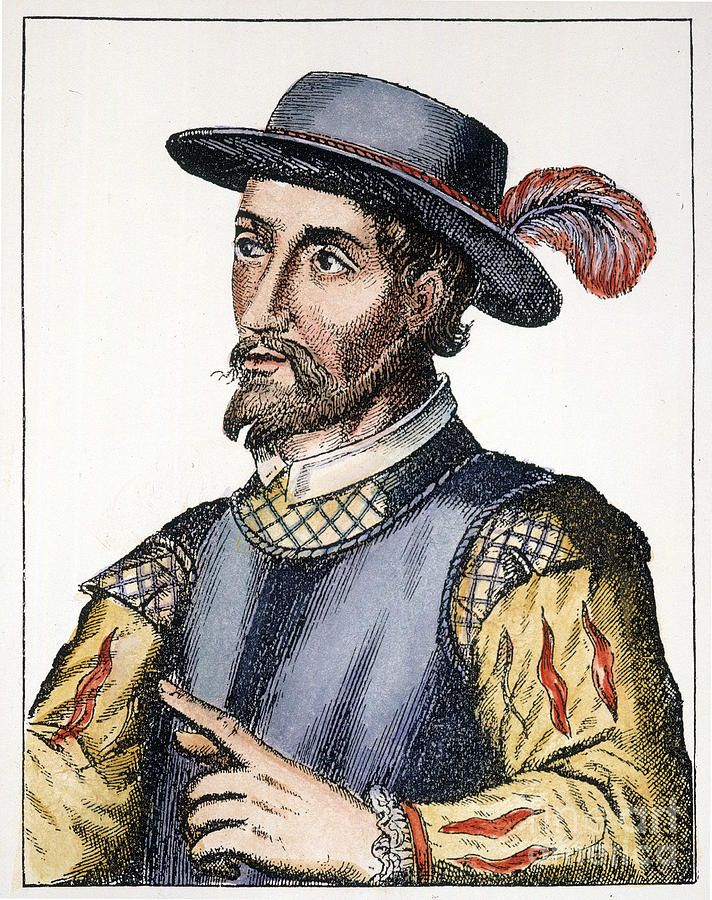
Juan Ponce de Leon
Image Credit: fineartamerica.com
Today is the 500th anniversary of Juan Ponce de Leon's discovery of Florida. In search of a "fountain of youth" and the obligatory Spanish goals of God, Glory and Gold (and not always in that order), Ponce de Leon landed on the east coast of Florida on April 2nd, 1513. The discovery was named Pascua de la Florida after the Easter "Feast of Flowers."

The first permanent settlement did not come until 1565 when Pedro Menendez de Aviles landed in today's St. Augustine. There, his chaplain celebrated the first Catholic Mass in today's United States.

This is a replica of the baptismal font used
to baptize Ponce de Leon in Spain in 1474.
This replica arrived at the Cathedral-Basilica of
St. Augustine in time for the Anniversary Mass
to be celebrated on April 3, 2013.
Info
The initial discovery of Florida five hundred years ago set off a very rich history for this peninsula, as well as shaping the colonial and naval development for three imperial powers - Spain, France and Britain. Florida provided a vital role because of its location to the Gulf Stream, an oceanic highway of sorts that connects shipping lanes of the Caribbean and Gulf of Mexico back to Europe via the North Atlantic. Spanish Florida expelled French Huguenots from Ft. Caroline on the St. John's River and the colony became a thorn to its British colonial neighbors to the north. After the Seven Years (a.k.a. French and Indian) War, Florida entered a 20-year period of British rule (1763-1783). Spanish and British architecture is still evident in St. Augustine today. After the U.S. War for Independence, Florida returned to Spanish rule and Loyalist exiles from  the British North American colonies were expelled, causing their second major migration in only a few years. After decades of shaky Spanish rule and an invasion by Andrew Jackson, Spain ceded Florida to the United States in 1819. The territory gained statehood status in 1845. By that time, the capital had moved from St. Augustine to Tallahassee. This was considered an ideal location as it was mid-way between the two most important cities at the time, St. Augustine and Pensacola. In 1861, Florida seceded from the Union, following the lead of six other slave states of the Deep South. Though Florida did not serve a central role in the Civil War due to its sparse population, its geographic location was vital. Florida was a cattle-rich state and its cattle fed the Confederacy. The Battle of Olustee and the occupation of Jacksonville were intended to cut off the cattle supply for the Confederacy, one segment of the Union's "Anaconda Plan." After the Civil War, Florida experienced a tremendous period of growth from the late 1800s well into the twentieth century. Jacksonville flourished as a tourist destination and the trade port of Tampa grew exponentially. Former Rockefeller associate Henry Flagler built railroads in the state. With a railroad to South Florida in the early twentieth century, combined with canal projects that made the land habitable, the development of the Miami region began.  This set off the largest period of growth in the state and a century that would witness an explosion of population due to the country's "sunbelt" migration as well as new job opportunities, including those created by NASA.  Florida's warm climate and sandy beaches already attracted plenty of tourists.  Tourism would explode in the state with the opening of Walt Disney World in 1971. Today, Florida continues to attract both tourists and new residents and remains one of the fastest growing states in the union.

This is simply a short summary of Florida's very rich and dynamic history.  Florida also has a very rich Catholic history which also will be celebrated this week, including a Mass celebrated tomorrow at the Cathedral-Basilica of St. Augustine.  The Bishop of St. Augustine, the Most Reverend Felipe Estevez, is certainly well-versed in Florida's Catholic history as evident by his homily given at his installation in 2011 (linked here).  Check out the resources below for more information on Florida history!

Viva Florida!


Book Recommendations:
I had the opportunity to read several books on Florida history as a student at the University of North Florida.  I had the privilege of learning under Dr. Daniel Schafer, one of the leading historians of state history and author of several books on key people in Florida History.  Here are a few of my favorite books on Florida:

  • The New History of Florida edited by Michael Gannon (1996)
  • The Oldest City: St. Augustine Saga of Survival edited by Jean Parker Waterbury and published by the St. Augustine Historical Society (1983)
  • Patrick D. Smith's A Land Remembered (1984).  This is a historical fiction novel set in Old Florida.  The novel portrays three generations of the MacIvey family who experience the frontier history of Florida from the 1860s through the twentieth century.  This book presented such a gripping story that I easily journeyed through its 400 pages in only a few days.  
  • James B. Crook's Jacksonville: The Consolidation Story, from Civil Rights to the Jaguars (2004).  I am certainly an enthusiast for my hometown and this is a great recent history book on Jacksonville!
  • A good read on the Catholic history of St. Augustine is Charles Gallagher's Cross & Crozier: A History of the Diocese of St. Augustine (1999).
Web Resources:

Twitter:

  • Hashtags: #florida500, #vivaflorida
  • @VivaFlorida - Official Twitter handle for the State's 500th Anniversary
  • @StAugustine450 - 450th Anniversary of St. Augustine
  • @FLMemory
Past Blog Posts:

Tuesday, January 1, 2013

Lincoln and Emancipation

Last week, I finished Doris Kearns Goodwin's comprehensive book, Team of Rivals. The central theme of this book is the "political genius of Abraham Lincoln." Goodwin meticulously examines the lives of Lincoln and his cabinet from their youth to the 1860 Republican Convention and throughout the four-year struggle of the Civil War. While the focus is on Lincoln, she also closely examines the lives of his political rivals who became part of his official political family - the cabinet. Assembling a cabinet of Republican rivals and Democrats, all who believed in 1860 that Lincoln was unqualified to be chief executive, truly was a strike of genius, especially on the brink of the worst crisis ever experienced by our nation. Though at times it seemed that Lincoln was swayed or even controlled by some in the cabinet, especially Seward, Lincoln truly was the captain at the helm. He utilized the diversity of his cabinet and even their competitiveness to strengthen the Union cause and effectively manage a challenging war, despite numerous obstacles and setbacks.

Lincoln Memorial, Washington, DC
(M. Broach, 2005)
Goodwin's book became the basis for Steven Spielberg's blockbuster hit, Lincoln, now appearing in theaters. Both the film and the book capture Lincoln's uniquely dynamic and attractive personality. It truly was Lincoln's charisma, insightful leadership and appealing good nature that made him the ideal president for guiding the union through four years of bloody civil war. It is hard to imagine how the nation would have fared if a Stephen Douglas, William Henry Seward or Salmon Chase had been president. Though Lincoln certainly could be moved on particular issues, he usually had a strongly formed position on the major issues of the day and then guided the nation, a union of radicals, moderates and conservatives, towards that position. He timed major decisions well and was uniquely able to disarm critics with an anecdote or story to prove a point. Even some of Lincoln's harshest critics came to see the wisdom of his vision: an indivisible nation that fulfilled the dream of the Founding Fathers - a republic of the people dedicated to the "proposition that all men are created equal."

This is a picture of the actual
Emancipation Proclamation (photo:
M. Broach, 2005)

Scanned Version
Today marks the 150th anniversary of the Emancipation Proclamation. This single act catapulted Lincoln to the fame he enjoys today and served as the critical turning point of the Civil War, making the Union cause one of freedom instead of simply political reunion. From early on, Lincoln detested slavery and viewed it as a moral evil. However, as a lawyer and politician, he held the view of many that it was a constitutionally protected institution in the South. As president, in the absence of war, he could only forbid slavery in lands controlled by the federal government - the western territories. This was his platform in the Election of 1860.  After the first shots of the Civil War, Radical Republicans and abolitionists pushed incessantly for emancipation. However, Lincoln hesitated, citing the cause of union as more important and questioning whether or not he had the legal authority to make such a bold move. As the war progressed and Union commanders began confiscating slaves as enemy property, the concept of emancipation loomed heavily on Lincoln and his cabinet. Lincoln took the wise view that he could not make any move until the Union had a significant victory on the battlefield. Furthermore, Lincoln still believed that any blanket emancipation order might drive the border states to the Confederacy or be held as legally invalid once the war concluded. Therefore, when the Emancipation Proclamation was announced in September 1862 after the victory at Antietam, it only applied to areas still in rebellion against the United States as of January 1, 1863. Lincoln was able to justify his legal qualms by using his extraordinary powers as commander-in-chief to issue this proclamation as a military measure in suppressing the rebellion. While some abolitionists criticized this move as a weak response to demands for ending slavery, Lincoln wisely knew that this action would help put slavery on the path of extinction. This proclamation also opened the door to the enlistment of colored troops, a critical dynamic in filling Union troop needs and as a powerful symbol to the South. Furthermore, by changing the nature of war from one of suppressing rebellion to one of ending slavery, the Emancipation Proclamation effectively closed the door to potential diplomatic recognition for the Confederacy by Great Britain or France.

The Thirteenth Amendment
(National Archives)
While the Emancipation Proclamation was Lincoln's tool for suppressing rebellion and winning the war, it was the first critical step in permanently ending slavery in the United States, especially with the promise that slaves would be "thenceforward and forever free."  As the Union finally began to turn the tide against the Confederacy and victory seemed near, Lincoln worked hard - despite warnings from his cabinet members - on a final solution to the slavery question, the Thirteenth Amendment. While some believed that Lincoln should wait for the end of the war to work on such an amendment, he instinctively knew that the promise of freedom for those African-Americans already freed by the Emancipation Proclamation must be secured before the end of the war less they be returned to bondage. The only way to ensure that he achieved the vision of finally ending slavery was to have the constitutional protection of freedom passed before the political debates of Reconstruction could take away the hopes of millions of slaves and former slaves.

The ending of slavery made the Civil War a second revolution, finally achieving the ideals espoused by the Founding Fathers.

As always, I conclude with additional resources:

Tuesday, October 30, 2012

Election 2012

Source: US News & World Report
Next week, most American voters will make a choice between the incumbent president, Barack Obama, and the challenger, former Governor Mitt Romney. This election season has been as intense as any and offers Americans a distinct choice between two very different economic ideologies and two very different visions for the United States in the world.

This may indeed be one of the more consequential elections in history, especially if the results of November 6th are as close as the polls today suggest. If that happens, the country may need to be re-educated on the Electoral College as occurred in the contentious Election of 2000.  In fact, given the number of "states in play" this election, there is a very small possibility of a tie in the Electoral College.  Should that rare event happen, the House of Representatives would choose the President and the Senate would choose the Vice President (Article II, Section 1 of the Constitution).  That would certainly be an interesting event.  Another possibility given recent polling is that one candidate could win the popular vote, while another wins the presidency through the Electoral College.  We will have to wait and see what happens next week.


For more information on how the two candidates are polling compared to the Electoral College, see the Real Clear Politics Electoral Map.


For this post, I thought I would take a look back at some of the most significant elections in U.S. History:


Election of 1796 - This election marked the beginning of the two-party political system that we are accustomed to today.  However, because of how the original Electoral College system worked, the election resulted in a president of one party and a vice president of another party.  Federalist President John Adams and Democratic-Republican Vice President Thomas Jefferson hoped that their personal friendship could allow for a functioning government.  That did not happen and led to the first real contentious election fight in American History, the Election of 1800.


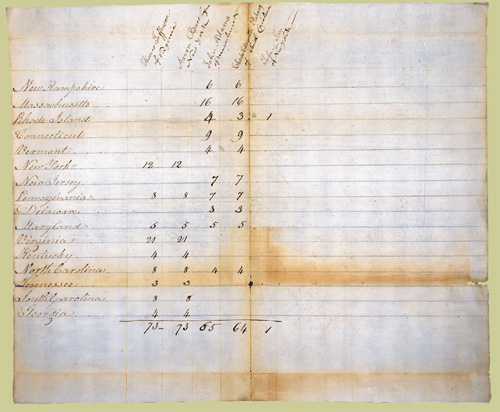
The Original Electoral College Vote of 1800 (National Archives)
Election of 1800 - This election season was as long as any and saw for the first time, a coordinated state-by-state effort by both parties to line up electoral votes. In the end, the "Jeffersonian Republicans" were the most effective. They were so effective at lining up disciplined electoral votes that the intended presidential candidate, Thomas Jefferson, received the same number of electoral votes as the intended vice presidential candidate Aaron Burr. With a tie in the Electoral College, the election went to the Federalist-controlled House which, after many threats and heated debates, selected Jefferson as President and Burr as Vice President. What made this election more significant than the electoral battle itself is that it marked the first transition of political power in American History. One ruling party stepped down peacefully while another gained power without making any drastic changes or witnessing any violence. This was remarkable for the time period, especially given recent European history.

Election of 1824 - After an eight year period of a one-party system, four candidates vied for the presidency in an election where some states were beginning to count the popular vote in elections. Furthermore, states were eliminating property requirements for voting ushering in the start of universal white male suffrage, known as an "era of the common man." In the final tally, Andrew Jackson emerged with more popular and electoral votes than any other candidate. However, he did not have a majority of all possible votes. By the Constitution, the election went to the House of Representatives. Under the leadership of Speaker Henry Clay who viewed Jackson as dangerous, the House chose John Quincy Adams instead. Jackson's supporters claimed a stolen election and the result was four years of misery for Adams.


Election of 1828 - Four years later, there was no electoral controversy in selecting Andrew Jackson as president. Two major developments came out of this election: (1) more "common men" now had the right to vote in an election where personal character attacks hit an all-time high and (2) the solidification of a distinct two-party political system.


Election of 1860 - Despite close electoral contests, partisanship or campaign controversies, every change in leadership has witnessed a peaceful transition of power - except this one.  Abraham Lincoln's election in 1860 without any southern electoral votes gave states like South Carolina an excuse to secede from the union.  That crisis led to four years of a bloody Civil War.  For more, see my related posts on the Civil War at 150. 

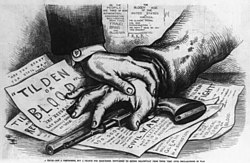
Election of 1876 - After bitter years of Civil War and Reconstruction, this election pitted Republican James Garfield against Democrat Samuel Tilden.  With a close campaign and a divided nation, the results were unclear.  Several states fielded disputed returns and without a clear winner in the Electoral College, the Congress convened a special electoral commission and by one vote, chose James Garfield.  It is reported that a deal was struck that in return for Garfield's election, he would remove the last remaining troops from the South officially ending Reconstruction.  With this "Compromise of 1877," Reconstruction faded away beginning an era of the "New South" and "Jim Crow." 

Election of 1896 - As the nineteenth century came to a close, Republican William McKinley defeated William Jennings Bryan who ran as both a Democrat and Populist.  This is one of the more fascinating races of the nineteenth century which served as a precursor to the types of campaigning that would take place in the twentieth century.  This was also the last election where the agrarian vote played a major role as the United States evolved into a mostly industrial economy. 

Source: RetroCampaigns.com
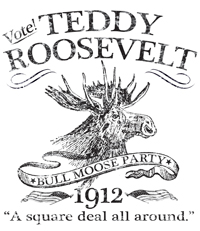
Election of 1912 - Similar to the current election battle, this election gave voters a distinct choice of differing economic visions for the future of the nation, albeit three choices.  Incumbent President William Howard Taft was challenged within the Republican Party by his predecessor, Theodore Roosevelt.  When Republicans nominated Taft for a second term over "TR," Roosevelt joined the Progressive Party and ran as a third-party candidate.  This party was nicknamed the "Bull Moose Party" after a famous TR speech.  With the split among normal Republican voters, Progressive Democrat Woodrow Wilson won the election with only 41% of the popular vote.  The major issue in this election, similar to today, involved the proper role of the federal government in the economy.  Wilson's election illustrates a general rule in the game of politics: when a traditional voting group is split in two, the other side usually wins (example: Bill Clinton's election in 1992 over George Bush and Ross Perot; exception to the rule: Truman's election in 1948).  Another notable fact, maybe an alarming one, is the 6% of the popular vote gained by Socialist candidate Eugene Debs. 

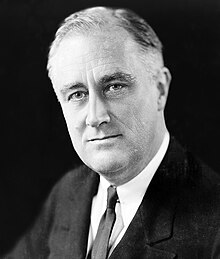
Election of 1932 - This election serves as the most famous example of the economy playing the deciding role in selecting a president.  In the depths of the Great Depression, voters overwhelming turned out Republican Herbert Hoover in favor of the eloquent Democrat from New York, Franklin D. Roosevelt and his "New Deal."  The New Deal initiated a dramatic change in the role of the federal government and led to the creation of dozens of government programs and regulatory agencies.  These initiatives relied on planned deficit spending, an idea still debated today and resulted in the doubling of the national debt.  Though many New Deal programs were temporary, some major reforms remain in place today - most famously, Social Security.  Unfortunately, the New Deal did not resolve the Great Depression and in fact, the economy got worse by the mid-1930s.  It would take the mobilization for World War II to finally lift the economy back to pre-1929 levels. 

Election of 1940 - Though Roosevelt's popularity declined in his second term, the overwhelming issue in this campaign was the outbreak of World War II in Europe.  As a result, voters chose to retain FDR for an unprecedented third term instead of selecting businessman Wendell Wilkie for the Oval Office. The possibility of a third term would be removed later by the Twenty-Second Amendment.

Election of 1948 - In another three-candidate race, President Harry Truman unexpectedly defeated Republican Thomas Dewey.  In this race, Truman was challenged from within his own party by Strom Thurmond who gained the nomination of the southern States Rights, or Dixiecrat, Party.  This election proved that the party split rule does not always apply.  Journalists had expected that the split in the Democrat vote would easily hand the election to Dewey.  Some newspapers ran the headline "Dewey defeats Truman" ahead of receiving the final results, now made famous by the image to the left. 

Election of 1952 - In this election, television played a major role for the first time as voters selected General Dwight Eisenhower over Democrat Adlai Stevenson.  For the influence of television in presidential campaigns, see the Museum of the Moving Image's site, The Living Room Candidate (www.livingroomcandidate.org).  This site archives hundreds of campaign commercials from every election, 1952 to 2008 (and soon, 2012).

Election of 1960 - Television continued to play an influential role in politics as this election witnessed the first televised debate between Democrat Senator John F. Kennedy and Republican Vice President Richard Nixon.  Kennedy's appeal on television boosted his image and aided in his eventual electoral victory, though the election was very close and is somewhat clouded with later reports of voter fraud. Kennedy is the first Catholic to be elected to the presidency.

Election of 1968 - This election served as one of the most divisive in history.  With the height of the controversial war in Vietnam, the stunning announcement that incumbent President Lyndon Johnson would not seek a second term and the assassinations of Martin Luther King and Robert Kennedy, this election produced another three-way split.  In a contentious nominating convention in Chicago with violent protests outside the convention hall, Democrats nominated Vice President Hubert Humphrey.  Republicans selected former Vice President Richard Nixon and southern Democrats formed the American Independent Party nominating former Alabama governor George Wallace for president.  Nixon easily won the election promising "peace with honor" in Vietnam. 

Election of 1980 - Ronald Reagan's election over Democrat Jimmy Carter in 1980 marked a change in the political landscape of the United States.  While the nation experienced what historians have labeled a "conservative revolution," the South began the transition from a Democrat stronghold to a mostly Republican region, at least in national elections.  Also, the politics of this era helped define the terms "conservative" and "liberal" used today. 

Source: CBSNews.com
Election of 1992 - As referenced earlier, this election helps support the party-split rule where Democrat Bill Clinton won the presidency with a minority of the popular vote over Republican George H.W. Bush and Independent Ross Perot. 

Source: USA Today
Election of 2000 - In one of the closest races in history, the results of this election between Republican Governor George W. Bush and Democrat Vice President Al Gore were unknown after election night.  As the results came in state-by-state, the race was "too close to call" in the Electoral College.  The final tally came down to the state of Florida where the race was also too close to call.  The first results indicated that George W. Bush had won Florida, but only by a small number of votes.  By state law, this close of an election result mandated a recount by hand.  This launched a media and legal circus in Florida lasting weeks as the physical recount took place.  In the end, the recount determined that Bush won Florida by 537 votes and thus, won all of Florida's 25 electoral votes placing him above the required 270 to win.  This result was later upheld by the United States Supreme Court in Bush v. Gore (2000).  George W. Bush won the presidency because he won in the Electoral College, even though Al Gore had won the popular vote.  The controversy did, however, serve to educate the public on the constitutional process of selecting a president. On a personal note, this was my first presidential election as a voter.

To understand the Electoral College system, see my handout linked here. 

Election of 2008 - Barack Obama is the first African-American elected to the presidency, certainly a historic moment.  Whether or not he has achieved his campaign promises will be decided by voters in this election.
Related Posts Plugin for WordPress, Blogger...